
Moeller 284388 NZM1-XUHIV20KL24AC undervoltage release 2VHI
Industrial Material > Control devices / Pilot devices > Breakers and disconnectors
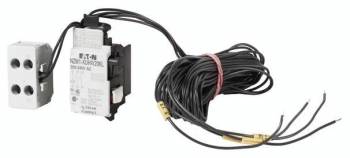
Moeller 284388 NZM1-XUHIV20KL24AC undervoltage release 2VHI
| Lieske Part No. | 194544 |
|---|---|
| Mfg Part No | 284388 |
| EAN-Code | 4015082843885 |
| Manufacturer | Eaton |
| Here only | 202,23 EUR
240,65 EUR incl. VAT
|
Further information for Moeller 284388 NZM1-XUHIV20KL24AC undervoltage release 2VHI
| General | |
| Operating voltage | 24 V AC |
| Number of auxiliary switches | 2 fS |
| Compatibility | NZM1(-4), N(S)1(-4) |
| Pre-actuation time auxiliary switch | 20 ms |
| Leading activation | |
Applications
The undervoltage release is used in installations where automatic disconnection is necessary in case of voltage drop or failure, to prevent damage to machines or systems. It is suitable for load shedding circuits and interlocking systems requiring safe and controlled disconnection of power supply. Another application is its use in conjunction with emergency stop devices, where the release is combined with an emergency stop switch to ensure immediate disconnection in emergencies. The function also prevents accidental contact with the main contacts of the switch during switching attempts when the load current release is activated.
Functions and Equipment in Detail
The release features pre-activation, which activates the undervoltage release before the actual switching operation when the switch is turned on. This ensures safe disconnection as soon as the voltage falls below a defined threshold. The version with two auxiliary switches (2fS) enables integration into complex control and monitoring systems. The auxiliary switches are designed to have a lead time of approximately 20 milliseconds during switch-on and switch-off operations (manual operation), enabling precise synchronization with other components.
Technology Explained Simply
The undervoltage release operates with a control voltage of 24 V AC and is therefore suitable for applications in electrical installations with this voltage. The pre-activation ensures that the release of the switch function occurs before the actual switching operation, increasing safety. The modular construction allows easy installation into the switch housings of the NZM series. The function of the release is designed to automatically open the switch in case of voltage drop to protect the installation. The auxiliary switches serve for signal transmission to external control devices or monitoring systems.
Compatibility and Accessories
The release is designed for use with circuit breakers of the NZM series, particularly types NZM1(-4) and N(S)1(-4). It can be used in combination with emergency stop switches to enable emergency disconnection. However, it is not possible to install the undervoltage release simultaneously with a pre-activated auxiliary switch (type NZM..-XHIV..) or a load current release (type NZM..-XA..). Additionally, use with a remote control module (type NZM..-XR..) is not permitted. Therefore, combination with other NZM series modules must be carefully planned to avoid compatibility conflicts.
Installation and Mounting
Mounting is done modularly into the housing of the NZM circuit breaker. The modular design allows for easy and quick installation without additional tools. The connection terminals are designed for connection to control wiring, with the exact terminal assignment to be taken from the technical documentation of the NZM series. The installation position and electrical connections must comply with the requirements of the respective switching system to ensure safe operation.
Advantages in Operation
The use of the undervoltage release increases safety in electrical installations, as it automatically opens the switch in case of voltage drop. The pre-activation ensures reliable and fast response, which is particularly advantageous in critical installations. Integration into existing control and monitoring systems via auxiliary switches enables comprehensive process monitoring. The modular design reduces installation effort and allows flexible adaptation to different requirements.

This is an offer of:
79279 Vörstetten
https://industry-electronics.com
Tel. 07666/88499-0
Fax. 07666/88499-111
Diesen Artikel finden Sie unter:
industry-electronics.com/artikel/194544

Lieske Elektronik e.K.
Reutener Str. 1079279 Vörstetten
https://industry-electronics.com
Tel. 07666/88499-0
Fax. 07666/88499-111
Diesen Artikel finden Sie unter:
industry-electronics.com/artikel/194544