
Moeller 281223 DILM32-XSPVL240 varistor circuit with LED
Industrial Material > Industrial relays and contactors > Contactors
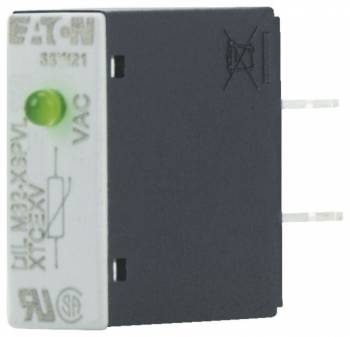
Moeller 281223 DILM32-XSPVL240 varistor circuit with LED
| Lieske Part No. | 865427 |
|---|---|
| Mfg Part No | 281223 |
| EAN-Code | 4015082812232 |
| Manufacturer | Eaton |
| Here only | 195,22 EUR
232,31 EUR incl. VAT
|
Further information for Moeller 281223 DILM32-XSPVL240 varistor circuit with LED
| General | |
| Degree of protection | varistor protection circuit |
| Operating voltage | 130 - 240 V AC |
| Accessory type | Protection circuitry |
| Compatibility | DILM17 - DILM32, DILK12 - DILK25, DILL, DILMP32 - DILMP45 |
| Indication | LED |
Applications
The varistor protection circuit is used in industrial plants where contactors and power contactors are installed in control and drive systems. It protects the control circuits against short-term voltage spikes caused by opening and closing of contacts or by network disturbances. The application is particularly suitable for contactors of types DILM17 to DILM32, DILK12 to DILK25, DILL, and DILMP32 to DILMP45. Thus, the circuit is suitable for a wide range of power contactors commonly used in industrial electrical engineering.
Functions and Equipment in Detail
The circuit integrates a varistor, which functions as an overvoltage protection device. When a voltage exceeds the permissible operating range (130–240 V AC), the varistor diverts the overvoltage current to protect the control circuits of the contactor. The integrated LED indicator serves as a visual status indicator, signaling the operating state of the circuit. The LED is integrated into the circuit and is powered by the control voltage. The circuit is designed as an accessory component to be attached to existing contactors to extend their protection function.
Technology Explained Simply
A varistor is a nonlinear resistor that exhibits high resistance under normal operating voltage, thus blocking current flow. When the voltage exceeds a certain threshold, the resistance of the varistor drops significantly, diverting the overvoltage current. This protects sensitive electronic components in the control circuit of the contactor. The LED indicator shows whether the circuit is connected and active. The circuit is designed for an operating voltage of 130 to 240 V AC, matching typical voltage ranges in industrial plants.
Compatibility and Accessories
The circuit is compatible with a range of contactor models from the DILM and DILK series, including DILM17 to DILM32, DILK12 to DILK25, DILL, and DILMP32 to DILMP45. It can be used as an addition to existing contactors to enhance their protection function. The use is in combination with power contactors employed in industrial drive systems, lighting controls, or other electrical installations. The circuit is not operated as a standalone device but is part of the control configuration of a contactor.
Mounting and Installation
Mounting is done directly onto the control terminals of the respective contactor. The circuit is connected to the control voltage terminals, taking polarity into account. The LED indicator is visible after installation and indicates the operating status. Installation requires no additional tools or special preparations, as the circuit is designed as standard accessory for the specified contactor models. The connection terminals are designed to ensure a secure and reliable connection.
Advantages in Operation
The use of the varistor protection circuit increases the reliability and service life of the control circuits of contactors. By protecting against transient overvoltages, the risk of damage to electronic components is reduced. The integrated LED indicator allows for quick visual inspection of the operating status, simplifying maintenance and troubleshooting. The circuit is compact and can be easily attached to existing contactors without requiring additional components or modifications. Compatibility with a wide range of models increases flexibility in system planning and expansion.

This is an offer of:
79279 Vörstetten
https://industry-electronics.com
Tel. 07666/88499-0
Fax. 07666/88499-111
Diesen Artikel finden Sie unter:
industry-electronics.com/artikel/865427

Lieske Elektronik e.K.
Reutener Str. 1079279 Vörstetten
https://industry-electronics.com
Tel. 07666/88499-0
Fax. 07666/88499-111
Diesen Artikel finden Sie unter:
industry-electronics.com/artikel/865427