
Moeller 276565 Contactor DILM7-10(24VDC) 3kW
Industrial Material > Industrial relays and contactors > Contactors
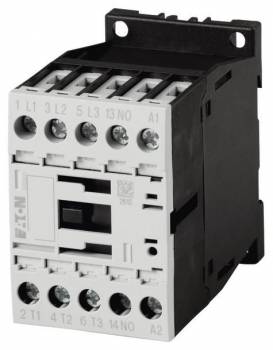
Moeller 276565 Contactor DILM7-10(24VDC) 3kW
| Lieske Part No. | 115620 |
|---|---|
| Mfg Part No | 276565 |
| EAN-Code | 4015082765651 |
| Manufacturer | Eaton |
| Here only | 58,44 EUR
69,54 EUR incl. VAT
|
Further information for Moeller 276565 Contactor DILM7-10(24VDC) 3kW
| General | |
| Manufacturer | Eaton |
| Number of poles | 3-pole |
| Operating voltage | 24 V DC |
| Rated operating current AC-3 | 7 A |
| Rated operational current AC-1 | 7 A |
| Connection system | Screw terminals |
| Utility category | AC-1, AC-3, AC-4 |
| Application | Power contactors for motors |
| Maximum current | 170 A |
| Power | 3 kW |
| Voltage | 400 V AC |
Applications
This contactor is designed for use in industrial installations, particularly in the machine and plant construction industry. It is used for the electrical control of electric motors and can be applied in systems with non-inductive or slightly inductive loads, such as resistance furnaces. The 3-pole configuration enables control of three-phase motors. The rating for 3 kW at 400 V AC makes it suitable for medium power requirements in production environments.
Functions and Equipment in Detail
The DILM7-10(24VDC) has a rated operational current of 7 A at AC-3 and 380 V or 400 V. This value refers to the thermal load capacity of the contactor under normal operating conditions. The operating voltage is 24 V DC, making it suitable for control systems in industrial environments with common low-voltage supplies. The screw terminals allow for a secure and mechanically stable connection of the wiring. The contactor is designed for use in systems with a maximum current of 170 A, with the specific model rated for 7 A.
Technology Explained Simply
The contactor operates on the principle of an electromagnetic switch. When the 24 V DC operating voltage is applied, the electromagnet is activated, closing the contacts and enabling the current circuit for the connected load (e.g., a motor). When the voltage is switched off, the contacts open again. The screw terminals ensure a mechanically stable and electrically reliable connection. The thermal load capacity of 7 A at AC-3 means the device can be operated continuously under these conditions without thermal overload occurring.
Compatibility and Accessories
The contactor is compatible with various accessories that extend its functionality. These include RC protection circuits such as the DILM12-XSPR500, which protect against voltage spikes. Time delay units such as the DILM32-XTEY20 or DILM32-XTED11-1(RAC240) enable time-delayed switching operations, for example for star-delta starting. Auxiliary switches such as the DILA-XHI20 or DILA-XHIV11 can be used to expand switching functions. Connectors such as the DILM32-XVB facilitate mounting and wiring. Motor protection relays such as the ZB12-0,16 or ZB12-2,4 provide additional protection for the connected motor.
Mounting and Installation
Mounting is carried out in the usual manner in enclosures or control cabinets. The screw terminals allow for easy and secure connection of the wiring. Installation must comply with applicable regulations for electrical installations. The rating for 24 V DC requires a corresponding control power supply. The connection terminals are designed for use with cables that match the respective current ratings and environmental conditions.
Advantages in Operation
The contactor provides reliable and low-maintenance control of electric motors. The use of screw terminals ensures a stable connection that remains secure even under vibration and mechanical stress. Compatibility with various accessories allows flexible adaptation to specific requirements. Suitability for motors of efficiency class IE3 supports energy-efficient system designs. The thermal load capacity of 7 A at AC-3 ensures safe operation under normal industrial conditions.

This is an offer of:
79279 Vörstetten
https://industry-electronics.com
Tel. 07666/88499-0
Fax. 07666/88499-111
Diesen Artikel finden Sie unter:
industry-electronics.com/artikel/115620

Lieske Elektronik e.K.
Reutener Str. 1079279 Vörstetten
https://industry-electronics.com
Tel. 07666/88499-0
Fax. 07666/88499-111
Diesen Artikel finden Sie unter:
industry-electronics.com/artikel/115620