
Moeller 265726 NZMB1-S40 power switch 3p 40 A
Industrial Material > Control devices / Pilot devices > Breakers and disconnectors
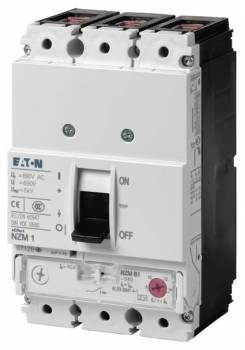
Moeller 265726 NZMB1-S40 power switch 3p 40 A
| Lieske Part No. | 138213 |
|---|---|
| Mfg Part No | 265726 |
| EAN-Code | 4015082657260 |
| Manufacturer | Eaton |
| Here only | 367,42 EUR
437,23 EUR incl. VAT
|
Further information for Moeller 265726 NZMB1-S40 power switch 3p 40 A
| General | |
| Poles | 3 p |
| Nominal current | 40 A |
| Switching category | AC-3 |
| Short-circuit release | Magnetic |
| Overload protection | With overload relay |
| Market suitability | IEC market |
| Construction size | NZM..-S |
| Function groups | Modular |
Applications
The NZMB1-S40 is designed for use in industrial electrical installations, particularly in drive technology, machine building, and process engineering. It meets the requirements of switching category AC-3, meaning it is suitable for operation with electric drives, such as three-phase motors. Switching category AC-3 includes operation with high inrush currents and frequent switching operations, ensuring the device's reliability under real operating conditions.
Functions and Equipment in Detail
The power switch features a magnetic short-circuit tripping unit, which quickly and safely disconnects the circuit in case of sudden overloads, such as those occurring during short circuits. Additionally, it is equipped with an overload relay that disconnects the switch in case of sustained overload, for example, for motor protection. This combination of short-circuit and overload protection provides comprehensive protection for connected devices and the entire installation. Alternatively, the switch can also be used without an overload tripping unit if only the short-circuit tripping unit is required.
Technology Explained Simply
The modular design of the NZMB1-S40 enables flexible mounting and expansion. Functional groups, such as undervoltage tripping units, mechanical interlocks, or additional handles, can be added according to application requirements. Switching category AC-3 ensures the switch remains stable even under frequent switching operations and high inrush currents. The use of a magnetic short-circuit tripping unit ensures rapid response to sudden current surges, while the overload relay detects slow, sustained overloads and reacts accordingly.
Compatibility and Accessories
The NZMB1-S40 can be combined with various accessories to adapt functionality to specific requirements. These include, for example, undervoltage tripping units such as the NZM1-XUHIV480-525AC or NZM1-XUHIV20L24DC, which automatically disconnect the switch during voltage dips. Mechanical interlocks such as the NZM1-XMV or lockable rotary handles such as the NZM1-XTVDV-60-NA increase safety and prevent unintentional operation. Additionally, enclosures such as the MCCB1-125/I43E-150 or MCCB1-63/I23E-150 are available, which integrate the switch into a closed enclosure.
Mounting and Installation
Mounting is carried out in standard enclosures, with the modular design enabling flexible placement. The size is compact, minimizing space requirements. Connections to conductors are made via tunnel terminals, such as the NZM1-XKAM, designed for cross-sections from 6 to 16 mm². Installation does not require special tools, as mounting is done via standard screw connections. The connection terminals are designed for use with cables in the specified cross-sections.
Advantages in Operation
The NZMB1-S40 offers high operational safety through the combination of short-circuit and overload protection. The modular design allows individual adaptation to the specific application, simplifying maintenance and expansion of the installation. Compliance with switching category AC-3 ensures long service life even under high loads. The compact design reduces space requirements in the enclosure and facilitates integration into existing systems.

This is an offer of:
79279 Vörstetten
https://industry-electronics.com
Tel. 07666/88499-0
Fax. 07666/88499-111
Diesen Artikel finden Sie unter:
industry-electronics.com/artikel/138213

Lieske Elektronik e.K.
Reutener Str. 1079279 Vörstetten
https://industry-electronics.com
Tel. 07666/88499-0
Fax. 07666/88499-111
Diesen Artikel finden Sie unter:
industry-electronics.com/artikel/138213