
Moeller 259653 undervoltage release 2VHI
Industrial Material > Control devices / Pilot devices > Breakers and disconnectors
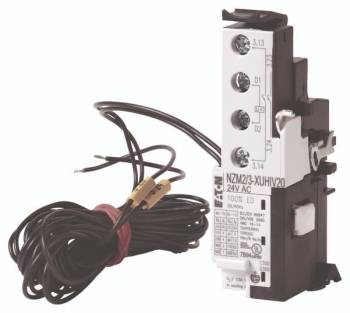
Moeller 259653 undervoltage release 2VHI
| Lieske Part No. | 281392 |
|---|---|
| Mfg Part No | 259653 |
| EAN-Code | 4015082596538 |
| Manufacturer | Eaton |
| Here only | 220,07 EUR
261,88 EUR incl. VAT
|
Further information for Moeller 259653 undervoltage release 2VHI
| General | |
| Compatibility | NZM2(-4), N(S)2(-4), NZM3(-4), N(S)3(-4) |
| Operating voltage | 380–440 V AC |
| Module type | 2VHI |
| Pre-actuation time auxiliary contacts | ca. 20 ms |
| Insert | emergency stop devices, main switch applications |
| Mounting method | modular function groups |
Applications
The undervoltage release is intended for use in industrial and commercial installations, particularly in systems requiring safe disconnection in case of voltage failure. It is frequently used in combination with emergency stop devices to immediately interrupt power supply in emergencies. The application is in switchgear with main and auxiliary circuits, where reliable response to voltage drops is critical. Compatibility is limited to switch types NZM2(-4), N(S)2(-4), NZM3(-4), N(S)3(-4).
Functions and Equipment in Detail
The release activates in case of voltage drop below the predefined threshold, leading to disconnection of the switch. It prevents accidental contact with main contacts during switching-on when the load current release is activated. The pre-activation function ensures that the undervoltage release is activated before the actual switching operation, increasing safety. The auxiliary contacts switch with a lead time of approximately 20 milliseconds during switching on and off (manual operation), enabling precise control of the installation.
Technology Explained Simply
The undervoltage release operates with a supply voltage of 380 to 440 volts AC. It is designed as a modular component integrated into the functional groups of NZM switches. The technology is based on an electromagnetic principle, where voltage is monitored and the release mechanism is activated when the threshold is undershot. The 2VHI module design enables easy installation and integration into existing switchgear. The function is independent of the main voltage and is powered via the network.
Compatibility and Accessories
The release is intended for switch types NZM2(-4), N(S)2(-4), NZM3(-4), N(S)3(-4). It cannot be used simultaneously with a remote control module (type NZM..-XR..). Also, simultaneous installation with a pre-activating auxiliary switch (type NZM..-XHIV..) or a load current release (type NZM..-XA..) is not possible. The use is in combination with emergency stop switches to ensure safe disconnection in emergencies.
Installation and Mounting
Mounting is done by installing into the modular functional groups of NZM switches. The modular design enables flexible and simple integration into existing installations. No additional tools or special mounting instructions are required, as the device is standardized. Installation is typically performed by qualified specialists during switchgear assembly.
Advantages in Operation
The use of the undervoltage release increases safety in industrial installations, as it ensures automatic disconnection in case of voltage drop. The pre-activation of release prevents unwanted switching-on operations and protects personnel and installation components. Integration into existing switchgear occurs without additional effort, as the module is directly installed into the functional group. The reliability of the functions ensures stable operation even under difficult conditions.

This is an offer of:
79279 Vörstetten
https://industry-electronics.com
Tel. 07666/88499-0
Fax. 07666/88499-111
Diesen Artikel finden Sie unter:
industry-electronics.com/artikel/281392

Lieske Elektronik e.K.
Reutener Str. 1079279 Vörstetten
https://industry-electronics.com
Tel. 07666/88499-0
Fax. 07666/88499-111
Diesen Artikel finden Sie unter:
industry-electronics.com/artikel/281392