
Moeller 259102 NZMH2-A200 power switch 3p 200 A
Industrial Material > Control devices / Pilot devices > Breakers and disconnectors
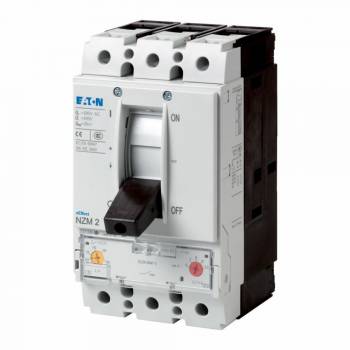
Moeller 259102 NZMH2-A200 power switch 3p 200 A
| Lieske Part No. | 774862 |
|---|---|
| Mfg Part No | 259102 |
| EAN-Code | 4015082591021 |
| Manufacturer | Eaton |
| Here only | 1.616,88 EUR
1.924,09 EUR incl. VAT
|
Further information for Moeller 259102 NZMH2-A200 power switch 3p 200 A
| General | |
| Number of poles | 3 way |
| Switching capacity (Icu) | 150 kA |
| Operating voltage | 400/415 V |
| Frequency | 50 Hz |
| Rated current (In = Iu) | 200 A |
| Installation type | Built-in installation |
| Connection technology | Screwed connection |
| Standard/approval | IEC |
| Protection function | plant and cable protection |
Applications
The NZMH2-A200 is designed for use in electrical distribution systems, particularly in industrial facilities, production sites, and machine building. It protects electrical systems and cables against overloads and short circuits. Due to its high switching capacity of 150 kA at 400/415 V and 50 Hz, it is suitable for applications with high energy demand and critical operating conditions. The protection function includes system and cable protection, ensuring the integrity of the electrical installation.
Functions and Equipment in Detail
The switch has a nominal current (In = Iu) of 200 A, meaning it can carry this current value continuously without thermal overload. The switching capacity of 150 kA at 400/415 V and 50 Hz ensures safe disconnection even under high short-circuit currents. The installation type is fixed mounting, meaning it is installed in enclosures or distribution systems. The screw connection enables a mechanically stable and electrically reliable connection to the conductors.
Technology Explained Simply
The NZMH2-A200 circuit breaker operates on the principle of mechanical disconnection in case of overload or short circuit. The protection function is implemented through integrated switching technology, which interrupts the circuit when the threshold value is reached. Standardization according to IEC ensures that the switch meets internationally recognized safety and quality requirements. The fixed mounting type means the switch is not replaceable but is permanently integrated into the control system.
Compatibility and Accessories
Various accessories are available to extend functionality and adapt to specific requirements. These include, for example, rotary handles such as the NZM2-XDVR (red-yellow, lockable) or the NZM2-XDV (lockable), enabling secure and visual operation. Remote actuators such as the NZM2-XRD110-130DC or NZM2-XR380-440AC allow remote control of the switch. Additionally, kits such as the NZM2-XHB-DA (with additional handle) or NZM2-XSRM-L (left side, red) are available to optimize operation. Warning signs such as ZFS61-NZM7 (German) or ZFS82-NZM (Chinese/English) serve for identification and safety. Undervoltage release units such as NZM2/3-XU48AC or NZM2-XUHIV110-130AC enable disconnection in case of voltage drop. Other components such as NZM-XDMI-DPV1 (Profibus-DPV1-Slave fieldbus connection) or PFR-WMA-70 (magnetic shielding for transformers) expand application possibilities.
Mounting and Installation
Mounting is done via fixed installation, where the switch is inserted into the designated control system and connected to the conductors using a screw connection. The screw connection ensures a mechanically stable and electrically reliable connection. Installation requires expertise in electrical engineering and must be carried out in accordance with applicable regulations.
Advantages in Operation
The NZMH2-A200 offers a high switching capacity of 150 kA, making it suitable for demanding industrial applications. The nominal current of 200 A allows use in systems with high energy demand. Standardization according to IEC ensures compliance with international standards. The availability of various accessories allows flexible adaptation to specific requirements, such as remote control, additional labeling, or fieldbus integration. The fixed mounting type ensures stable and durable integration into the control system.

This is an offer of:
79279 Vörstetten
https://industry-electronics.com
Tel. 07666/88499-0
Fax. 07666/88499-111
Diesen Artikel finden Sie unter:
industry-electronics.com/artikel/774862

Lieske Elektronik e.K.
Reutener Str. 1079279 Vörstetten
https://industry-electronics.com
Tel. 07666/88499-0
Fax. 07666/88499-111
Diesen Artikel finden Sie unter:
industry-electronics.com/artikel/774862