
Moeller 259099 NZMH2-A100 3P 100A Switch Disconnector
Industrial Material > Control devices / Pilot devices > Breakers and disconnectors
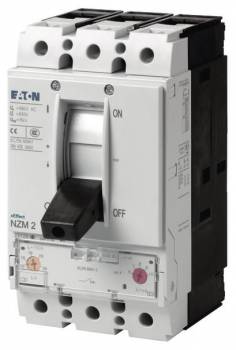
Moeller 259099 NZMH2-A100 3P 100A Switch Disconnector
| Lieske Part No. | 730107 |
|---|---|
| Mfg Part No | 259099 |
| EAN-Code | 4015082590994 |
| Manufacturer | Eaton |
| Here only | 750,88 EUR
893,55 EUR incl. VAT
|
Further information for Moeller 259099 NZMH2-A100 3P 100A Switch Disconnector
| General | |
| Switching capacity (Icu) | 150 kA |
| Operating voltage | 400/415 V |
| Frequency | 50 Hz |
| Rated current (In = Iu) | 100 A |
| Number of poles | 3 way |
| Installation type | Built-in installation |
| Connection technology | Screwed connection |
| Standard/approval | IEC |
| Protection function | plant and cable protection |
Applications
The switch is intended for use in industrial and commercial electrical installations, particularly in systems requiring high protection against short circuits and overloads. It is suitable for drives, lighting systems, heating systems, and other electrical loads that must be switched via a 3-pole protection. Standardization according to IEC ensures compliance with international standards for safety and reliability.
Functions and Equipment in Detail
The NZMH2-A100 provides installation and cable protection, achieved through the integrated protection function. This protection function ensures that the switch automatically disconnects in case of overload or short circuit, protecting the electrical installation from damage. The rated current of 100 A corresponds to the rated continuous current (In = Iu), meaning the switch can be continuously loaded with this current without thermal overload. The switching capacity of 150 kA at 400/415 V and 50 Hz (Icu) demonstrates the switch’s ability to safely interrupt high short-circuit currents.
Technology Explained Simply
The switch is designed for fixed installation, meaning it is built into a distribution unit or enclosure and is not movable. The screw connection ensures a mechanically stable and electrically reliable connection of conductors. Standardization according to IEC ensures compliance with international standards, which are important for safety and interoperability in electrical installations. The protection function for installations and cables safeguards the entire electrical installation against overloads and short circuits.
Compatibility and Accessories
Various accessories are available to extend functionality and adapt to specific requirements. These include main switch kits such as the NZM2-XSR-R (right side, red) or NZM2-XHB (black), enabling visual control of the switching state. Undervoltage release units such as the NZM2/3-XU110-130DC or NZM2/3-XUHIV20LK24AC ensure the switch automatically disconnects when the supply voltage is interrupted. Remote control units such as the NZM2-XR380-440AC or NZM2-XRD208-240AC allow remote operation of the switch. Additional handles such as the NZM1/2-XDZ or rotary handles such as the NZM2-XTVDVR-60 (Red-Yellow, lockable) offer ergonomic operating options. Insulating housing such as the NZM2-XCI43-TVD or frame terminal NZM2-160-XKC support safe mounting and connection.
Mounting and Installation
The switch is intended for fixed installation and is mounted using a screw connection into a distribution unit or enclosure. Mounting is carried out in the usual manner for power switches of this size, with electrical connections to be securely and firmly screwed. Compliance with IEC standards must be observed during installation to ensure the safety and reliability of the installation.
Advantages in Operation
The NZMH2-A100 offers high reliability and safety through its protection functions and high switching capacity. The fixed installation type and screw connection ensure a stable and durable installation. Compatibility with various accessories allows flexible adaptation to different requirements. Standardization according to IEC ensures interoperability and safety in international installations.

This is an offer of:
79279 Vörstetten
https://industry-electronics.com
Tel. 07666/88499-0
Fax. 07666/88499-111
Diesen Artikel finden Sie unter:
industry-electronics.com/artikel/730107

Lieske Elektronik e.K.
Reutener Str. 1079279 Vörstetten
https://industry-electronics.com
Tel. 07666/88499-0
Fax. 07666/88499-111
Diesen Artikel finden Sie unter:
industry-electronics.com/artikel/730107