
Moeller 248856 Z-SCH230/63-40 heating contactor 230 VAC
Installation > Modular devices / equipment installation > Heating contactor
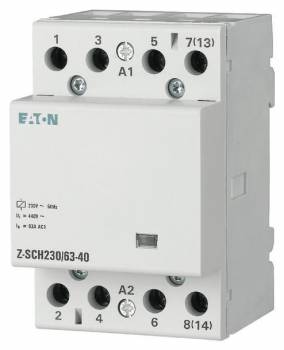
Moeller 248856 Z-SCH230/63-40 heating contactor 230 VAC
| Lieske Part No. | 177397 |
|---|---|
| Mfg Part No | 248856 |
| EAN-Code | 4015082488567 |
| Manufacturer | Eaton |
| Here only | 243,75 EUR
290,06 EUR incl. VAT
|
Further information for Moeller 248856 Z-SCH230/63-40 heating contactor 230 VAC
| General | |
| Control voltage | 230 V AC |
| Rated operation current | 63 A |
| Function | 4 S |
| Standards | IEC 61095, EN 61095, VDE 0660, IEC 60947-4-1, EN 60947-4-1 |
| Mounting method | DIN rail mounting |
| Mounting width | 3 SU |
| Cap dimension | 45 mm |
Applications
This contactor is primarily intended for use in heating systems, where it enables remote activation or deactivation of heating elements. It is suitable for applications requiring safe and reliable switching functions, such as in building technology, industrial heating systems, or process control. Compliance with standards ensures adherence to safety and functional requirements in electrical installations.
Functions and Equipment in Detail
The device features four closers (4 S), which close the circuit when the contactor is actuated. The control voltage is 230 V AC, a standard voltage in electrical installation technology, enabling compatibility with common control devices and relays. The rating of 63 A for AC1 indicates that it is designed for resistive loads without high switching surges or inductive loads. The switching function is contact-controlled, with contacts mechanically actuated to enable or interrupt current flow.
Technology Explained Simply
Control is achieved via an external control voltage of 230 V AC, applied to the control terminals of the contactor. When voltage is applied, an electromagnet is activated, moving the contacts and thus closing the main current circuit. The contacts are configured as closers, meaning they are open in the resting state and only close the circuit when actuated. The standard IEC 60947-4-1 defines requirements for contact-controlled switches, including electrical and mechanical life, switching capacity, and safety requirements. Compliance with these standards ensures reliable and safe operation of the device.
Compatibility and Accessories
The contactor is designed for mounting on a DIN rail structure, a standard mounting method in electrical installations. It is compatible with other devices mounted on DIN rails, such as circuit breakers, fuses, or other contactors. The mounting width of 3 SU (52.5 mm) allows for compact placement in enclosures. The cap height of 45 mm is relevant for mechanical fixation and spacing from adjacent components.
Mounting and Installation
Mounting is performed on a DIN rail structure, with the device clamped onto the rail using integrated holders. Electrical connections are made via the main terminals for the load and the control terminals for the control voltage. The terminals are designed for cable connections, with cross-section specifications to be observed according to standards and the device's rating. Installation must comply with applicable regulations and standards, particularly VDE 0660, which defines requirements for the installation of contactors and switching devices.
Advantages in Operation
The contactor provides reliable switching for resistive loads with a rated current of 63 A. Compliance with standards ensures adherence to safety and functional requirements. DIN rail mounting enables quick and easy installation in enclosures. Control via 230 V AC is compatible with common control devices, facilitating integration into existing systems. The 4 S function allows simultaneous switching of multiple circuits, which is advantageous in complex installations.

This is an offer of:
79279 Vörstetten
https://industry-electronics.com
Tel. 07666/88499-0
Fax. 07666/88499-111
Diesen Artikel finden Sie unter:
industry-electronics.com/artikel/177397

Lieske Elektronik e.K.
Reutener Str. 1079279 Vörstetten
https://industry-electronics.com
Tel. 07666/88499-0
Fax. 07666/88499-111
Diesen Artikel finden Sie unter:
industry-electronics.com/artikel/177397