
Moeller 231080 M22-XLED230-T LED test element AC
Industrial Material > Control devices / Pilot devices > Built-Command and signaling devices
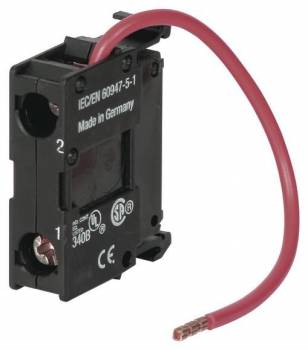
Moeller 231080 M22-XLED230-T LED test element AC
| Lieske Part No. | 923919 |
|---|---|
| Mfg Part No | 231080 |
| EAN-Code | 4015082310806 |
| Manufacturer | Eaton |
| Here only | 181,35 EUR
215,81 EUR incl. VAT
|
Further information for Moeller 231080 M22-XLED230-T LED test element AC
| Features | |
| Product colour | Black |
| International Protection (IP) code | IP20 |
LED test element
The M22-XLED230-T is not a standalone indicator element, but an add-on module integrated into existing control panels. It enables the simultaneous activation of all connected LED light elements that are equipped with a compatible module. Without this button, the test function is not available. Control is achieved via an electrical connection established during installation. The LED elements themselves light up in their respective colors, while the test element does not produce any color itself, but only controls the activation.
Application areas
The test element is primarily intended for industrial applications where quick and reliable testing of indicator lights is required. It is used in control and operating panels equipped with RMQ-Titan LED modules. The application is for indoor use only, as protection class IP20 does not provide protection against moisture or splashing water. Therefore, use is restricted to dry, protected environments, such as machine control systems, plant monitoring systems, or electrical enclosures.
Functions and equipment in detail
The module is designed for use with AC systems and is powered by the existing power supply of the control panel. It requires no additional power source or external energy supply. Installation is carried out by inserting the module into the designated mounting area of the control panel, with electrical connections to the test button and LED modules required. Compatibility is limited to LED modules that feature a special test module. The function is purely diagnostic and does not serve signal transmission or processing, but rather visual testing of the lighting function.
Technology explained simply
The technology of the M22-XLED230-T is based on an electrical control system triggered by a button. When the button is pressed, a signal is sent to all connected LED modules, which then illuminate briefly. Protection class IP20 means the device is not protected against dust or water, but only against larger foreign objects and splashing water. This is sufficient for use in dry indoor environments, but not for environments with high humidity or direct wetness.
Compatibility and accessories
The test element is specifically developed for LED modules of the RMQ-Titan system. It requires the use of LED elements equipped with a compatible test module. The function is only available if a test button is integrated into the control panel. Use with other LED systems or without a test button is not intended and will result in non-functionality.
Mounting and installation
Mounting is done by inserting the module into the designated mounting area of the control panel. Electrical connections are made via existing terminals in the enclosure. No additional tools or mounting aids are required, as the module fits standard mounting openings. Installation requires knowledge of electrical installation and compliance with electrical safety regulations. The connection to the test button and LED modules must be correctly established to ensure functionality.
Advantages in operation
Using the M22-XLED230-T enables efficient and quick testing of indicator lights. Instead of checking each LED element individually, the operator can activate all lights simultaneously by pressing the test button. This reduces maintenance time and increases system reliability, as malfunctions can be quickly identified. The function is easy to operate and requires no special software or additional devices. Integration into existing systems is straightforward, provided the prerequisites (compatible LED modules and test button) are met.

This is an offer of:
79279 Vörstetten
https://industry-electronics.com
Tel. 07666/88499-0
Fax. 07666/88499-111
Diesen Artikel finden Sie unter:
industry-electronics.com/artikel/923919

Lieske Elektronik e.K.
Reutener Str. 1079279 Vörstetten
https://industry-electronics.com
Tel. 07666/88499-0
Fax. 07666/88499-111
Diesen Artikel finden Sie unter:
industry-electronics.com/artikel/923919