
Moeller Electric 199459 DILM12-XHI31-PI auxiliary switch module 4p
Industrial Material > Control devices / Pilot devices > Motor protection switch
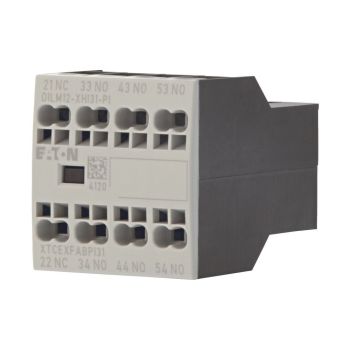
Moeller Electric 199459 DILM12-XHI31-PI auxiliary switch module 4p
| Lieske Part No. | 1061235 |
|---|---|
| Mfg Part No | 199459 |
| EAN-Code | 4015081978656 |
| Manufacturer | Eaton |
| Here only | 23,41 EUR
27,86 EUR incl. VAT
|
Further information for Moeller Electric 199459 DILM12-XHI31-PI auxiliary switch module 4p
| General | |
| Number of poles | 4 |
| Connection system | Push-in terminals |
| Thermal operating current (Ith) | 16 A |
| Rated operational current AC-15 | 4 A |
| Voltage range AC-15 | 220 V, 230 V, 240 V, 380 V, 400 V, 415 V |
| Contact configuration | 3 normally open contacts (NO), 1 normally closed contact (NC) |
| Mounting type | Front fastening |
| Compatibility | DILM7.-PI, DILM9.-PI, DILM12.-PI, DILM15.-PI, DILMP20.-PI |
| Function | for standard applications |
| Contact carrier | Forced-guided contacts |
| Mirror contact | |
Applications
This auxiliary switch module is designed for use in industrial plants where additional signal transmission or status indication is required. It is frequently used in conjunction with motor protection switches and contactors to monitor the operating status of a motor or machine. Typical applications include control systems for pumps, fans, conveyor systems, or machine tools. Compatibility with various models of the DILM series – such as DILM7.-PI, DILM9.-PI, DILM12.-PI, DILM15.-PI, and DILMP20.-PI – enables flexible integration into existing systems.
Functions and Features in Detail
The module is designed for standard applications and offers a rated operational current (Ie) of 4 A at voltages of 220 V, 230 V, 240 V, as well as 380 V, 400 V, and 415 V under AC-15 operating duty. The thermal current rating (Ith) is 16 A, defining the load capacity under continuous operating conditions. The mechanically interlocked contacts ensure stable switching performance even under mechanical stress or vibrations. Front mounting allows for easy installation directly on the front of the main device, minimizing space requirements in the enclosure.
Technology Explained Simply
The push-in terminals allow for quick and secure wire connections without additional tools. The contacts are designed to be mechanically interlocked, meaning they switch precisely regardless of the position of the main contact. This is particularly important in installations subjected to high mechanical stress or vibrating environments. The switching function is performed via three normally open contacts and one normally closed contact, making the module suitable for both signal transmission and status feedback. The IEC/EN 60947-5-1 Annex L standard is considered for the mechanical interlocking of contacts, enhancing the reliability of the circuit.
Compatibility and Accessories
The auxiliary switch module is specifically developed for use with contactors from the DILM series by Eaton. It is compatible with models such as DILM7.-PI, DILM9.-PI, DILM12.-PI, DILM15.-PI, and DILMP20.-PI. Integration is achieved via front mounting, allowing direct installation on the front of the main device. In combination with other components of the DILM series, such as contactors with various operating voltages (24 V DC, 230 V AC, 42 V AC), it can be used in diverse control systems. Use as a mirror contact according to IEC/EN 60947-4-1 Annex F is also possible, enabling integration into circuits with additional safety functions.
Mounting and Installation
Mounting is performed via front mounting on a compatible contactor. The push-in terminals allow for tool-free wire connections, enabling quick and secure installation. Positioning is directly on the front of the device, reducing space requirements in the enclosure. Electrical connections are made via designated terminals, with the contact configuration (3 S, 1 Ö) to be considered. No additional tools or special mounting aids are required for installation.
Operational Advantages
The auxiliary switch module provides reliable switching performance through mechanically interlocked contacts that remain stable even under mechanical stress. The push-in terminals reduce installation time and increase connection safety. Compatibility with various models of the DILM series enables flexible use in existing installations. The rating for 4 A at various voltages makes it suitable for a wide range of applications. Front mounting optimizes space usage in the enclosure and facilitates maintenance.

This is an offer of:
79279 Vörstetten
https://industry-electronics.com
Tel. 07666/88499-0
Fax. 07666/88499-111
Diesen Artikel finden Sie unter:
industry-electronics.com/artikel/1061235

Lieske Elektronik e.K.
Reutener Str. 1079279 Vörstetten
https://industry-electronics.com
Tel. 07666/88499-0
Fax. 07666/88499-111
Diesen Artikel finden Sie unter:
industry-electronics.com/artikel/1061235