
Eaton 199221 power contactor 3p 380V
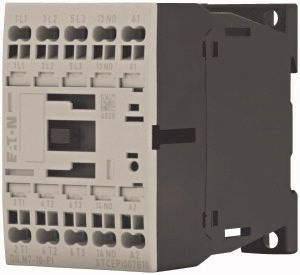
Eaton 199221 power contactor 3p 380V
| Lieske Part No. | 1873288 |
|---|---|
| Mfg Part No | 199221 |
| EAN-Code | 4015081973057 |
| Manufacturer | Eaton |
| Here only | 34,65 EUR
41,23 EUR incl. VAT
|
Further information for Eaton 199221 power contactor 3p 380V
| General | |
| Number of poles | 3 way |
| Rated operating current AC-3 | 7 A |
| Rated operational current AC-1 (open) | 22 A |
| Rated operational current AC-1 (enclosed) | 18 A |
| Operating voltage | 24 V AC/DC |
| Frequency | 50/60 Hz |
| Connection system | Push-in terminals |
| Utility category | AC-1, NAC-3, AC-4 |
| Application | Contactors for motors, contactors up to 95 A |
| Notes | Suitable also for motors of efficiency class IE3 |
Applications
This contactor is used in industrial electrical engineering, particularly for controlling electric motors in production plants, conveyor systems, or machine building. It is suitable for usage categories AC-1 (non-inductive or slightly inductive loads), NAC-3 (starting and switching off squirrel-cage motors), and AC-4 (starting, plugging, reversing, jogging). These categories define the mechanical and thermal stresses the device must withstand. Rating is specified for an operating voltage of 380 V and 400 V, which is typical for industrial supply voltages.
Functions and Equipment in Detail
The contactor has a rated operational current (Ie) of 7 A under AC-3 conditions (380 V/400 V). The conventional thermal current (Ith) is 22 A for open construction and 18 A for enclosed construction at an ambient temperature of 40 °C. These values define the maximum current load the device can withstand continuously without thermal overload. The push-in terminals allow for quick and reliable connections without additional tools, simplifying installation and maintenance.
Technology Explained Simply
The contactor operates using a coil that generates a magnetic field when the operating voltage (24 V AC/DC) is applied, attracting the armature and closing the main contacts. When the voltage is switched off, the armature returns by spring force and opens the contacts. The 3-pole design enables control of three-phase motors. The thermal rating (Ith) accounts for heat generation during operation, with the value being lower for enclosed construction due to restricted heat dissipation.
Compatibility and Accessories
The contactor is compatible with various accessory modules that extend its functionality. These include auxiliary switch modules such as DILM32-XHI11-PI (2p, Ith=16A) or DILM32-XHI31-PI (4p, Ith=16A), which enable additional switching functions for controls or signals. Time-delay modules such as DILM32-XTED11-10(RA24) (0.5–10 s delayed reset) or DILM32-XTED11-100(RA24) (5–100 s latched reset) allow time-controlled switching operations. Other components such as varistors (e.g. DILM12-XSPV48) or motor interference suppressors (DILM12-XMSM) serve protective functions against overvoltages and disturbances. A test cube (DILM32-XMAN) enables functional testing of the contactor.
Mounting and Installation
Mounting is carried out in standard control panels or enclosures. The push-in terminals allow for quick and secure connection of cables. The connection terminals are designed for easy handling, with exact connection specifications (e.g. conductor cross-section) to be found in the technical data sheets. Installation must comply with applicable standards and regulations for electrical installations.
Advantages in Operation
The contactor provides reliable and maintenance-friendly motor control. The push-in technology reduces installation time and minimizes error sources. The thermal design ensures stable operation even during prolonged use. Compatibility with various accessory modules allows flexible adaptation to specific requirements in control engineering. Suitability for motors of efficiency class IE3 supports energy-efficient system designs.

This is an offer of:
79279 Vörstetten
https://industry-electronics.com
Tel. 07666/88499-0
Fax. 07666/88499-111
Diesen Artikel finden Sie unter:
industry-electronics.com/artikel/1873288

Lieske Elektronik e.K.
Reutener Str. 1079279 Vörstetten
https://industry-electronics.com
Tel. 07666/88499-0
Fax. 07666/88499-111
Diesen Artikel finden Sie unter:
industry-electronics.com/artikel/1873288