
Moeller 198554 speed controller 4.3 A
Industrial Material > Industrial relays and contactors > Switching units / measuring, control relay
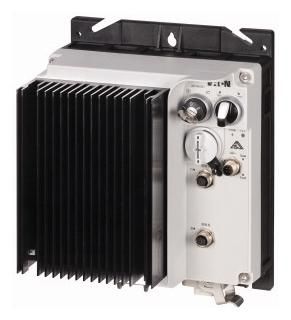
Moeller 198554 speed controller 4.3 A
| Lieske Part No. | 2058219 |
|---|---|
| Mfg Part No | 198554 |
| EAN-Code | 4015081964291 |
| Manufacturer | Eaton |
| Here only | 1.238,61 EUR
1.473,95 EUR incl. VAT
|
Further information for Moeller 198554 speed controller 4.3 A
| General | |
| Nominal power | 1,5 kW |
| Nominal current | 4,3 A |
| Sensor input | 4 |
| AS-Interface® version | S-7.4 |
| Maximum number of participants | 31 |
| Compatibility | AS-Interface® |
| Product type | Speed controller |
Applications
The speed controller is intended for use in industrial environments, particularly in systems requiring variable speed control, such as in packaging industry, conveying technology, or machine tools. The use of AS-Interface® enables easy integration into existing automation systems, especially when AS-Interface® cables and components are already in use.
Functions and Equipment in Detail
The device features a sensor input 4, designed for connecting external sensors or switches to enable additional control functions such as position detection, status monitoring, or safety functions. Control is performed via the AS-Interface® network, enabling communication with the higher-level control system (e.g. PLC) through a single cable. The maximum of 31 participants in the network allows for flexible and scalable system design.
Technology Explained Simply
The speed controller operates with an electronic control system that adjusts voltage and frequency to the motor to achieve the desired speed. Communication via AS-Interface® takes place over a 2-wire cable, which carries both data transmission and power supply (similar to PoE, but specifically for AS-Interface®). Control is performed over a network consisting of a master (e.g. a PLC) and multiple slaves (such as the speed controller). The S-7.4 specification refers to the AS-Interface® version, which offers higher data rates and extended functions such as support for multiple participants.
Compatibility and Accessories
The device can be combined with various accessory components intended for connecting and expanding the system. These include, for example, motor cables such as RASP-CM2-2M0 (2 m length), branch connectors such as ZB2-100-AZ1 for M12 connectors, and power adapter cables such as RA-C3/C2-1,5HF or RA-C3/C1-1,5HF. Extension cables such as RA-XM12-1M (1 m M12 female/male connector) allow flexible cabling. Additionally, a converter DX-CBL-PC-3M0 is available, enabling connection to frequency converters DA1 and DC1. These components are intended for expanding and adapting the installation to specific requirements.
Mounting and Installation
Wiring is performed via the AS-Interface® cable, which carries both power supply and data transmission. Connection points for motor cables and sensors are provided according to the device designation. Installation requires integration into an existing AS-Interface® network, with configuration performed via the higher-level control system.
Advantages in Operation
The speed controller offers reliable and precise speed control, distinguished by easy integration into AS-Interface® systems. The use of a single cable for data and power reduces cabling complexity and reduces susceptibility to errors. Support for up to 31 participants enables flexible system expansion. Connecting sensors via sensor input 4 extends functionality and enables comprehensive process monitoring. The devices are designed for industrial use and offer a robust construction for use in production environments.
AS-Interface® is an open, standardized communication protocol for decentralized peripherals in automation technology. It enables the connection of sensors, actuators, and control devices via a simple 2-wire cable, thereby reducing cabling costs and complexity. Version S-7.4 offers extended functions and higher data rates compared to earlier versions. The term speed controller describes the core function of the device, namely the control of an electric motor's speed. The rated power of 1.5 kW and the rated current of 4.3 A define the electrical limits of the device. The sensor input 4 enables connection of external sensors to extend control functions.

This is an offer of:
79279 Vörstetten
https://industry-electronics.com
Tel. 07666/88499-0
Fax. 07666/88499-111
Diesen Artikel finden Sie unter:
industry-electronics.com/artikel/2058219

Lieske Elektronik e.K.
Reutener Str. 1079279 Vörstetten
https://industry-electronics.com
Tel. 07666/88499-0
Fax. 07666/88499-111
Diesen Artikel finden Sie unter:
industry-electronics.com/artikel/2058219