
Eaton ZEB32-20-GF/KK overload relay electronic 4-20 A
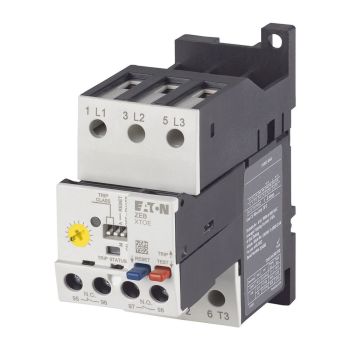
Eaton ZEB32-20-GF/KK overload relay electronic 4-20 A
| Lieske Part No. | 1601559 |
|---|---|
| Mfg Part No | 136500 |
| EAN-Code | 4015081332809 |
| Manufacturer | Eaton |
| Here only | 224,04 EUR
266,61 EUR incl. VAT
|
Further information for Eaton ZEB32-20-GF/KK overload relay electronic 4-20 A
| General | |
| Rated current range | 4-20 A |
| Degree of protection | IP20 |
| Phase failure sensitivity | IEC/EN 60947, VDE 0660 Part 102 |
| Reset function | manual/auto-reset selectable |
| Protection against heavy start | Class 10 to Class 20 |
| Mounting type | Separate positioning |
| Auxiliary contacts Normally open (NO) | 1 |
| Auxiliary contacts normally closed (NC) | 1 |
| Suitable for | DILM17, DILM25, DILM32, DILM38, DIULM17, DIULM25, DIULM32, SDAINLM30, SDAINLM45, SDAINLM55 |
| Standards and regulations | IEC/EN 60947, VDE 0660, UL, CSA |
Applications
This relay is suitable for use in industrial plants where electric motors with nominal currents between 4 and 20 A are operated. It is commonly used in manufacturing plants, process engineering, or building automation systems where reliable motor monitoring is required. Compatibility with various contactor types enables flexible integration into existing control systems.
Functions and Equipment in Detail
The device features a Test/Off button and a Reset button, enabling manual testing and resetting of the relay. The reset function can be set to either manual or auto-reset, allowing the operator to choose whether to reset the relay manually or automatically after a tripping event, depending on requirements. The overload protection is designed for starting classes 10 to 20, enabling adaptation to different starting conditions. The integrated auxiliary contacts include one normally open contact (1 S) and one normally closed contact (1 Ö), which can be used for additional control or signaling tasks.
Technology Explained Simply
The electronic overload relay continuously monitors the current consumption of the connected motor. When a critical current value, exceeding the set nominal current, is reached, the relay trips and disconnects the motor from the power supply to prevent damage. The phase failure sensitivity ensures that a protective trip also occurs if one or more phases fail in the three-phase power supply. The protection rating IP20 means the device is protected against contact with fingers and against solid foreign objects, but not against water or dust — it is therefore intended for use in enclosed, dry control cabinets.
Compatibility and Accessories
The relay is compatible with a range of contactor types, including models SDAINLM30, SDAINLM45, and SDAINLM55, which are available in various voltage variants (e.g. 230 V/50 Hz, 400 V/50 Hz, 24 V DC). Depending on the application scenario, the appropriate contactors can be selected to control the motor according to the electrical conditions of the installation. Combining the relay with these contactors enables a modular and scalable solution for different motor power ratings.
Mounting and Installation
Mounting is typically done on a standard rail (e.g. DIN rail), with electrical connections made according to the technical specifications of the respective contactor and relay types. Compliance with standards IEC/EN 60947, VDE 0660, UL, and CSA ensures conformity with international safety and quality requirements.
Operational Advantages
The electronic control enables precise and reproducible monitoring of motor current, thereby extending motor lifespan and minimizing downtime. The selectable reset function (manual/auto) offers flexibility in operation, while the integrated auxiliary contacts enable additional functions such as alarm signaling or status indication. Compliance with international standards ensures safe and reliable performance in various application environments.

This is an offer of:
79279 Vörstetten
https://industry-electronics.com
Tel. 07666/88499-0
Fax. 07666/88499-111
Diesen Artikel finden Sie unter:
industry-electronics.com/artikel/1601559

Lieske Elektronik e.K.
Reutener Str. 1079279 Vörstetten
https://industry-electronics.com
Tel. 07666/88499-0
Fax. 07666/88499-111
Diesen Artikel finden Sie unter:
industry-electronics.com/artikel/1601559