
Moeller 127733 load disconnect switch 4p 200A 1000VDC
Industrial Material > Industrial relays and contactors > Switching units / measuring, control relay
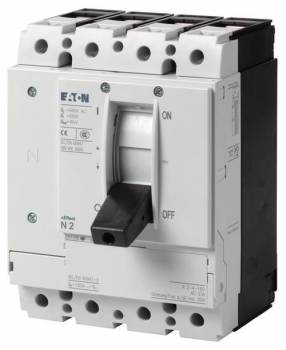
Moeller 127733 load disconnect switch 4p 200A 1000VDC
| Lieske Part No. | 100188 |
|---|---|
| Mfg Part No | 127733 |
| EAN-Code | 4015081251438 |
| Manufacturer | Eaton |
| Here only | 1.281,47 EUR
1.524,95 EUR incl. VAT
|
Further information for Moeller 127733 load disconnect switch 4p 200A 1000VDC
| General | |
| Nominal voltage | 1000 V DC |
| Nominal current | 200 A |
| Number of poles | 4 p |
| Maximum operating voltage | 1500 V DC |
| Insulation resistance | for earthed IT networks |
| Disconnecting properties | in accordance with IEC/EN 60947-3 and VDE 0660 |
| Main switch properties | in accordance with IEC/EN 60204 and VDE 0113 |
| Utilization | for 1 or 2 poles |
| Bridge kits | Required for 2-pole circuit |
| Positive drive | |
Applications
The disconnect switch is intended for use in industrial distribution systems, particularly in installations with DC power supply, such as in power engineering, automation technology, or in systems with storage and solar installations. The design allows for individual integration into various switchgear, with mounting possible on distributors, enclosures, or switchboards. Use in earthed IT networks extends its application range in safety-critical areas.
Functions and Equipment in Detail
The switch provides the necessary disconnection characteristics in accordance with IEC/EN 60947-3 and VDE 0660, ensuring safe electrical disconnection. The characteristics of the main switch, including mandatory drive, comply with standards IEC/EN 60204 and VDE 0113, ensuring reliability during mechanical operation. The construction allows for mounting of additional equipment such as bridge kits, connection terminals, and rotary handles for door couplings, enabling adaptation to specific requirements. These options allow for flexible integration into existing switchgear.
Technology Explained Simply
The switch is designed for load disconnection, where the circuit can be disconnected under load, but not for switching off short-circuit currents. The rated voltage of 1000 V DC and the rated current of 200 A define the maximum operating conditions. The special version for up to 1500 V DC expands the range of applications, although the actual operating voltage is limited to 1000 V DC. The insulation capability for earthed IT networks means the switch can also operate safely in systems with an earthed neutral conductor. The use of bridge kits enables series connection in two-pole switching, which is required in certain system configurations.
Compatibility and Accessories
In addition to the base unit, various accessories can be used to extend functionality. These include undervoltage release units such as the NZM2/3-XUHIV20380-440AC or NZM2/3-XU220-250DC, load current release units such as the NZM2/3-XA208-250AC/DC, and remote control units such as the NZM2-XR220-250DC. Covers such as the NZM2-XAVPR or insulating housing such as the NZM2-XCI43-TVD support safety and protection. Door coupling rotary handles such as the NZM2-XTVDV-60-NA enable safe operation through doors. Cable lugs such as the KS120-NZM7 support connections with larger conductors. Combination with plug-in or withdrawable technologies is not possible according to the information provided.
Mounting and Installation
Mounting is carried out in enclosures or distributors, with the use of bridge kits required for two-pole switching. The connection terminals are designed for cable connections, with the use of cable lugs such as the KS120-NZM7 recommended. Installation of rotary handles for door couplings requires a corresponding hole and shaft, with the maximum shaft length being 60 mm. The switches are not designed for plug-in or withdrawable mounting concepts.
Advantages in Operation
The switch provides safe disconnection during operation, supported by compliance with standards and the possibility of integrating additional functions. The use of auxiliary switches, voltage-free disconnection, and remote controls facilitates signaling and automation. The construction allows for individual adaptation to various distribution systems, increasing flexibility in industrial applications. Reliability is ensured by compliance with standards IEC/EN 60204, VDE 0113, IEC/EN 60947-3, and VDE 0660.

This is an offer of:
79279 Vörstetten
https://industry-electronics.com
Tel. 07666/88499-0
Fax. 07666/88499-111
Diesen Artikel finden Sie unter:
industry-electronics.com/artikel/100188

Lieske Elektronik e.K.
Reutener Str. 1079279 Vörstetten
https://industry-electronics.com
Tel. 07666/88499-0
Fax. 07666/88499-111
Diesen Artikel finden Sie unter:
industry-electronics.com/artikel/100188