
Moeller 118703 Safety Relay 24VAC-DC
Industrial Material > Industrial relays and contactors > Safety relay
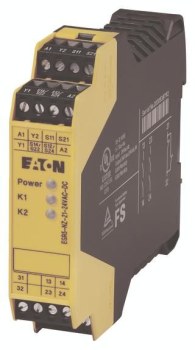
Moeller 118703 Safety Relay 24VAC-DC
| Lieske Part No. | 697418 |
|---|---|
| Mfg Part No | 118703 |
| EAN-Code | 4015081168439 |
| Manufacturer | Eaton |
| Here only | 313,11 EUR
372,60 EUR incl. VAT
|
Further information for Moeller 118703 Safety Relay 24VAC-DC
| General | |
| Supply voltage | 24 V AC/DC |
| Number of release current paths | 2 - |
| Stop category | 0 - |
| Alarm current path | 1 - |
| Degree of protection | IP20 - |
| Installation location IP rating | at least IP54 - |
| Rated surge voltage | 6 kV |
| Insulation | reinforced - |
| Safety function | Two-hand function, safety door - |
| Certification | EN574 Type IIIC, EN 954-1 Cat. 4, EN ISO 13849-1 PL e, IEC 62061 SILCL 3, IEC 61508 SIL 3 - |
| Separation | secure disconnection - |
| Mounting method | Busbar - |
| Actuation | Vertical from front - |
| Cover | Busbar cover according to EN 50274 - |
Applications
This relay is designed for applications complying with the requirements of standard EN574 Type IIIC, as well as EN 954-1 Category 4, EN ISO 13849-1 Performance Level PL e, IEC 62061 SILCL 3, and IEC 61508 SIL 3. These certifications make it suitable for machines requiring high safety integrity, such as in manufacturing, machine tool construction, or packaging industries. Typical applications include use in conjunction with emergency stop switches, safety doors, or two-hand controls to enable operation only when specific safety conditions are met.
Functions and Equipment in Detail
The relay features a busbar cover according to EN 50274, enabling vertical actuation from the front. This design is finger- and back-of-hand-safe, ensuring compliance with safety regulations during installation and maintenance. The integrated alarm current path function allows error or fault indication in the system, simplifying diagnosis and maintenance. The rated impulse voltage is 6 kV, enhancing robustness against transient voltage surges.
Technology Explained Simply
The two-channel design means two independent safety paths operate in parallel, minimizing the likelihood of malfunction if one channel fails. Stop Category 0 according to IEC/EN 60204 means the device immediately stops the machine as soon as a safety switch is activated. Safe separation and reinforced insulation ensure no hazardous electrical connection exists between the safety circuits and the main power circuit, reducing the risk of short circuits or incorrect control.
Compatibility and Accessories
The relay can be combined with other components from the ESR5 product portfolio to implement extended safety functions. These include, for example, the ESR5-NV3-30 delayed safety relay 24 V DC, the ESR5-NO-31-230VAC safety relay 230 V AC/DC, the ESR5-NOS-31-230VAC single-channel safety relay 230 V AC/DC, the ESR5-VE3-42 delayed contact extension 24 V DC, and the EATON ESR5-NO-31-UC safety relay for emergency stop monitoring. These modules can be used depending on requirements to extend safety functions or integrate into existing systems.
Mounting and Installation
Mounting is done on a standard busbar, with the cover enabling vertical actuation from the front. The installation location must have at least protection rating IP54 to ensure the relay’s functionality. The relay itself has protection rating IP20, meaning it is protected against contact with fingers and larger objects, but not against dust or splashing water. Installation is carried out in enclosed enclosures that meet the required environmental conditions.
Advantages in Operation
The combination of two-channel safety architecture, safe separations, and certification according to international standards ensures high reliability and safety in operation. The integrated alarm function enables quick fault detection, optimizing operational uptime and maintenance intervals. Compatibility with other ESR5 modules allows flexible expansion of safety functions without changing the basic architecture.

This is an offer of:
79279 Vörstetten
https://industry-electronics.com
Tel. 07666/88499-0
Fax. 07666/88499-111
Diesen Artikel finden Sie unter:
industry-electronics.com/artikel/697418

Lieske Elektronik e.K.
Reutener Str. 1079279 Vörstetten
https://industry-electronics.com
Tel. 07666/88499-0
Fax. 07666/88499-111
Diesen Artikel finden Sie unter:
industry-electronics.com/artikel/697418