
Moeller 110302 NZMN3-A320-BT power switch 3p 320 A
Industrial Material > Control devices / Pilot devices > Breakers and disconnectors
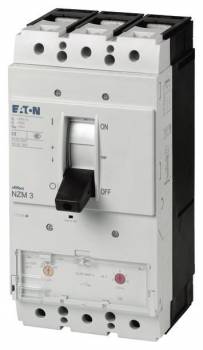
Moeller 110302 NZMN3-A320-BT power switch 3p 320 A
| Lieske Part No. | 316228 |
|---|---|
| Mfg Part No | 110302 |
| EAN-Code | 4015081098507 |
| Manufacturer | Eaton |
| Here only | 2.412,76 EUR
2.871,18 EUR incl. VAT
|
Further information for Moeller 110302 NZMN3-A320-BT power switch 3p 320 A
| General | |
| Number of poles | 3 way |
| Rated current | 320 A |
| Rated continuous current | 320 A |
| Switching capacity | 50 kA |
| Nominal voltage | 400/415 V |
| Frequency | 50 Hz |
| Installation type | Built-in installation |
| Connection type | Frame clamp |
| Standard/approval | IEC |
| Protection function | plant and cable protection |
Applications
The NZMN3-A320-BT is designed for use in medium to heavy industrial installations where high switching performance and reliability are required. It is suitable, for example, for powering machines, production lines, or larger consumers in manufacturing technology. The 3-pole configuration makes it particularly suitable for three-phase AC installations, which are common in industry. The rating for 320 A allows operation of installations with high current consumption values without overloading the switching component.
Functions and Equipment in Detail
The switch features a frame terminal, ensuring a secure and stable connection to the connecting conductors. The rated continuous current (In = Iu) is 320 A, meaning the switch can continuously carry this current value without thermal overload. The switching capacity of 50 kA at 400/415 V 50 Hz ensures that the switch can safely disconnect even under high short-circuit currents. The plant and cable protection function ensures that both the electrical installation and the connected cables are protected from damage caused by overload or short circuit.
Technology Explained Simply
The power switch operates on the principle of mechanical switching, where the electrical circuit is interrupted by a movable contact component. The frame terminal allows for simple and secure mounting of the supply lines. The rating for 320 A means the switch is designed for installations that continuously carry this current value. The switching capacity of 50 kA indicates how much energy the switch can dissipate during a short circuit without failing. IEC standardization ensures that the switch meets internationally recognized safety and quality standards.
Compatibility and Accessories
The NZMN3-A320-BT can be combined with various accessories to adapt functionality to specific requirements. These include, for example, current trip units such as the NZM2/3-XAHIV208-250AC/DC or NZM2/3-XAHIV380-440AC/DC, designed for different voltage ranges. Remote actuators such as the NZM3-XR24-30DC enable remote operation. Additionally, connection extenders (e.g. NZM3-XKV70-2), cable lugs (e.g. NZM3-XKS240), and cover caps (e.g. NZM3-XKSAV) are available to optimize mounting and protect connections. The use of mechanical interlocks (e.g. NZM2/3-XMVR) can enhance safety during operation.
Mounting and Installation
Mounting is performed as fixed installation, with the switch installed into a suitable enclosure. The frame terminals allow for direct and secure connection of supply lines. Installation does not require special tools, but correct polarity and compliance with electrical standards must be ensured. The rating for 320 A requires appropriately sized conductors to ensure safe current transmission.
Advantages in Operation
The switch offers high reliability and safety due to its switching capacity of 50 kA and integrated protection function. IEC standardization enables international use. The frame terminals ensure a stable and maintenance-friendly connection. Compatibility with various accessories allows flexible adaptation to different requirements in industrial electrical engineering. The fixed mounting type ensures secure installation in enclosures and prevents unintended movement or disconnection of connections.

This is an offer of:
79279 Vörstetten
https://industry-electronics.com
Tel. 07666/88499-0
Fax. 07666/88499-111
Diesen Artikel finden Sie unter:
industry-electronics.com/artikel/316228

Lieske Elektronik e.K.
Reutener Str. 1079279 Vörstetten
https://industry-electronics.com
Tel. 07666/88499-0
Fax. 07666/88499-111
Diesen Artikel finden Sie unter:
industry-electronics.com/artikel/316228