
Moeller 102682 power switch 3p 100 A
Industrial Material > Control devices / Pilot devices > Breakers and disconnectors
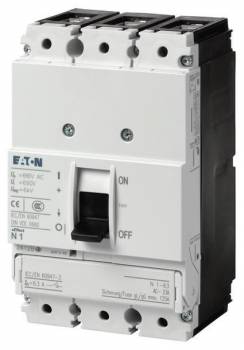
Moeller 102682 power switch 3p 100 A
| Lieske Part No. | 955488 |
|---|---|
| Mfg Part No | 102682 |
| EAN-Code | 4015081025428 |
| Manufacturer | Eaton |
| Here only | 489,39 EUR
582,37 EUR incl. VAT
|
Further information for Moeller 102682 power switch 3p 100 A
| General | |
| Degree of protection | Load isolation switch / main switch |
| Number of poles | 3 way |
| Rated current | 100 A |
| Rated continuous current | 100 A |
| Switching capacity SCCR | 35 kA |
| Operating voltage | 480Y/277 V |
| Frequency | 60 Hz |
| Installation type | Built-in installation |
| Terminal technology | Frame clamp |
| Standard/approval | UL/CSA, IEC |
| Product type | Molded Case Switch |
Applications
The NS1-100-NA is used in industrial electrical engineering, particularly in enclosures and distributions, where safe and manual disconnection of power supply is required. It is designed for installations with an operating voltage of 480Y/277 V at 60 Hz. The protective function as a switch disconnector allows disconnection of the load from the network, enabling safe maintenance or inspection of downstream equipment. Certifications according to UL/CSA and IEC guarantee compliance with international safety and quality standards.
Functions and Equipment in Detail
The switch has a short-circuit rating (SCCR) of 35 kA at 480Y/277 V and 60 Hz, ensuring high short-circuit resistance and thus safe disconnection in case of faults or overloads. The nominal current is 100 A, with the nominal continuous current (In = Iu) also being 100 A. This means the switch can continuously carry a current of 100 A without thermal overload. Installation is as a fixed mounting, with the frame terminal providing a secure mechanical connection to the connecting conductors.
Technology Explained Simply
The Molded Case Switch is a power switch with a housing made of molded plastics, protecting the electrical components and providing high insulation performance. The 3-pole configuration enables disconnection of all three phases of a three-phase system. The protective function as a switch disconnector means the switch does not provide protection against overload or short circuit, but exclusively enables mechanical disconnection of the power supply. Certification according to UL/CSA and IEC ensures suitability for use in various markets, particularly in North America and Europe.
Compatibility and Accessories
Various accessories are available for this switch, extending its functionality. These include, for example, insulating housing such as NZM1-XCI23-TVD, providing additional protection, and rotary handles such as NZM1-XDTVR in red-yellow, enabling lockable operation. Other options include under-voltage release units such as NZM1-XUVHIV20L, which automatically disconnect the switch during voltage dips, and tunnel terminals such as NZM1-XKAM for secure connection of cables with cross-sections up to 6x16 mm². Warning signs such as ZFS61-NZM7 in German language can be used to indicate the switch position.
Mounting and Installation
Mounting is as a fixed installation in enclosures or distributions. The frame terminal enables a secure and mechanically stable connection to the connecting conductors. Installation does not require special tools, but proper wiring and securing are necessary to ensure electrical safety. The switch position is visually identifiable, allowing the operating state (on/off) to be easily checked.
Advantages in Operation
The NS1-100-NA offers high reliability in disconnecting electrical loads. The robust construction and certification according to UL/CSA and IEC ensure safe and standard-compliant use. The high short-circuit resistance of 35 kA protects the installation during faults. The combination with accessories such as lockable rotary handles or under-voltage release units extends functionality and allows application-specific adaptation to the requirements of the electrical installation.

This is an offer of:
79279 Vörstetten
https://industry-electronics.com
Tel. 07666/88499-0
Fax. 07666/88499-111
Diesen Artikel finden Sie unter:
industry-electronics.com/artikel/955488

Lieske Elektronik e.K.
Reutener Str. 1079279 Vörstetten
https://industry-electronics.com
Tel. 07666/88499-0
Fax. 07666/88499-111
Diesen Artikel finden Sie unter:
industry-electronics.com/artikel/955488