
Moeller 082882 NHI-E-11-PKZ0 Auxiliary Contact 1S1Ö
Industrial Material > Control devices / Pilot devices > Motor protection switch
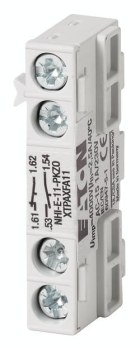
Moeller 082882 NHI-E-11-PKZ0 Auxiliary Contact 1S1Ö
| Lieske Part No. | 725337 |
|---|---|
| Mfg Part No | 082882 |
| EAN-Code | 4015080828822 |
| Manufacturer | Eaton |
| Here only | 15,36 EUR
18,28 EUR incl. VAT
|
Further information for Moeller 082882 NHI-E-11-PKZ0 Auxiliary Contact 1S1Ö
| Features | |
| Product colour | White |
| Operating temperature (T-T) | -25 - 55 °C |
| Weight & dimensions | |
| Width | 25 mm |
| Depth | 75.2 mm |
| Height | 92.4 mm |
Applications
The auxiliary switch is designed for use in industrial plants, particularly in combination with motor protection switches used in pump, fan or conveyor systems. It enables the integration of control and monitoring functions into existing switching systems without requiring additional switching devices. Typical use cases include control systems for machine building, conveyor technology or building technology, where motor or transformer status monitoring is required.
Functions and Equipment in Detail
The switch is equipped with a simple contact module that is directly installed into the control unit of a motor protection switch. The contacts are designed for transmitting control signals, with the close contact (1S) being activated when the motor is running and the open contact (1Oe) being released during shutdown or fault condition. This function enables the actuation of auxiliary devices such as warning lights, relays or indicator instruments. The product colour is white, ensuring clear visibility in control panels and contributing to standardisation in industrial installations.
Technology Explained Simply
The auxiliary switch operates mechanically in synchrony with the main contact of the motor protection switch to which it is mounted. When the motor protection switch turns on the motor, the auxiliary switch is also actuated, closing the close contact while opening the open contact. During shutdown or a protective trip (e.g. overload, short circuit), the open contact closes and the close contact opens. This mechanical coupling ensures reliable signal transmission without requiring additional electrical amplification. The operating temperature ranges from -25 °C to +55 °C, enabling use in a wide range of environments, including climatically demanding industrial facilities.
Compatibility and Accessories
The switch is specifically designed for use with motor protection switches from the series PKZM01, PKZM0, PKZM4, PKZM0-T, PKM0 and PKE. It can be combined with various models from these series to integrate additional control functions. Compatible devices include, for example, the PKZM0-16-T transformer protection switch, the PKM0-4 motor protection switch, or the PKZM0-2,5/AK motor protection switch. Combining these devices expands the functionality of the switching system without requiring additional space in the control panel.
t
Mounting and Installation
The auxiliary switch is directly installed into the motor protection switch, with mounting achieved via a mechanical locking mechanism. Installation requires no additional tools or components, as the switch is specifically designed for the respective series. Dimensions are 25 mm (width), 75.2 mm (depth) and 92.4 mm (height), allowing compact placement in standard control panels. The mounting width of 25 mm corresponds to the standard module for DIN rail mounting, enabling easy integration into existing installations.
Advantages in Operation
Integrating the auxiliary switch into the motor protection switch makes the switching system more compact and clear. Signal transmission occurs directly and reliably, without additional cabling or external relays. The operating temperature of -25 to +55 °C ensures stable performance even in climatically demanding environments. The mechanical coupling with the main contact ensures exact signal synchronisation, which is crucial for the reliability of control and monitoring systems. Use in combination with the specified motor protection switches allows flexible adaptation to different applications without requiring additional devices.

This is an offer of:
79279 Vörstetten
https://industry-electronics.com
Tel. 07666/88499-0
Fax. 07666/88499-111
Diesen Artikel finden Sie unter:
industry-electronics.com/artikel/725337

Lieske Elektronik e.K.
Reutener Str. 1079279 Vörstetten
https://industry-electronics.com
Tel. 07666/88499-0
Fax. 07666/88499-111
Diesen Artikel finden Sie unter:
industry-electronics.com/artikel/725337