
Moeller 073145 U-PKZ0(208V60HZ) undervoltage release instantaneous
Industrial Material > Control devices / Pilot devices > Breakers and disconnectors
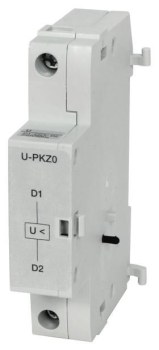
Moeller 073145 U-PKZ0(208V60HZ) undervoltage release instantaneous
| Lieske Part No. | 325017 |
|---|---|
| Mfg Part No | 073145 |
| EAN-Code | 4015080731450 |
| Manufacturer | Eaton |
| Here only | 47,48 EUR
56,50 EUR incl. VAT
|
Further information for Moeller 073145 U-PKZ0(208V60HZ) undervoltage release instantaneous
| General | |
| Manufacturer | Eaton |
| Function | Under voltage coil |
| Tripping characteristic | Undelayed |
| Compatibility | circuit breaker size PKZ(M)0 |
| Operating voltage | 208 V |
| Frequency | 60 Hz |
Applications
The undervoltage release is used in industrial and commercial electrical installations where continuous and stable voltage supply is necessary for the operational safety of machines and systems. It is specifically designed for circuit breakers of size PKZ(M)0, which are used in medium to high power ranges. Typical application scenarios include protecting production lines, pumps, fans, lighting systems, or other electrical loads where voltage interruption is undesirable. The instantaneous tripping ensures that the circuit breaker reacts immediately as soon as the voltage drops below the predefined threshold.
Functions and Equipment in Detail
The release operates as an electromechanical relay that continuously monitors the voltage in the network. In the event of undervoltage, the magnetic drive is activated, triggering the circuit breaker's operating mechanism and thereby interrupting the circuit. The tripping occurs without delay, meaning no time delay is built in – the reaction is direct and immediate. This is particularly important in installations where immediate disconnection is necessary to prevent damage. The release is designed for an operating voltage of 208 V at 60 Hz, indicating a specific network configuration common in certain countries or regions.
Technology Explained Simply
The undervoltage release uses an electromagnetic principle, where a coil system monitors the voltage in the network. When the voltage drops below the defined level, the magnetic flux in the coil system is reduced, activating the tripping function. The tripping is carried out via a mechanical lever that actuates the circuit breaker's operating mechanism. The construction is designed to fit into size PKZ(M)0, with installation integrated directly into the circuit breaker. The operating voltage of 208 V at 60 Hz is a fixed parameter that cannot be changed – the release is not suitable for other voltages or frequencies.
Compatibility and Accessories
The undervoltage release is exclusively intended for circuit breakers of size PKZ(M)0. It is not compatible with other sizes or switch types. Use in other devices is not intended and may lead to malfunctions. There are no specific accessories mentioned in connection with this item. Installation is direct into the circuit breaker, requiring no additional components or tools beyond the circuit breaker itself.
Installation and Mounting
Installation is carried out by inserting the release into the circuit breaker of size PKZ(M)0. The release is placed into the designated socket and mechanically secured. Electrical connection is made via the integrated terminal clamps, which are connected to the network conductors. Installation requires no additional components or tools beyond the circuit breaker. Correct installation is essential to ensure proper function. The operating voltage of 208 V at 60 Hz must be present in the network to operate the release correctly.
Operation
Operation of the undervoltage release is maintenance-free as long as it is used in the intended environment and with the correct voltage. The instantaneous tripping ensures that the protective function becomes effective immediately when the voltage drops below the threshold. This protects connected devices from damage due to insufficient voltage. The reliability of the release depends on correct installation and adherence to the specific operating conditions. Regular functional testing is recommended to ensure continued operability.

This is an offer of:
79279 Vörstetten
https://industry-electronics.com
Tel. 07666/88499-0
Fax. 07666/88499-111
Diesen Artikel finden Sie unter:
industry-electronics.com/artikel/325017

Lieske Elektronik e.K.
Reutener Str. 1079279 Vörstetten
https://industry-electronics.com
Tel. 07666/88499-0
Fax. 07666/88499-111
Diesen Artikel finden Sie unter:
industry-electronics.com/artikel/325017