
Moeller 051795 Contactor 4 kW 3p
Industrial Material > Industrial relays and contactors > Contactors
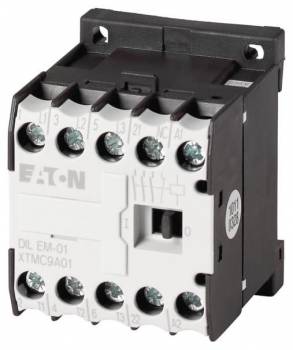
Moeller 051795 Contactor 4 kW 3p
| Lieske Part No. | 924696 |
|---|---|
| Mfg Part No | 051795 |
| EAN-Code | 4015080517955 |
| Manufacturer | Eaton |
| Here only | 52,14 EUR
62,05 EUR incl. VAT
|
Further information for Moeller 051795 Contactor 4 kW 3p
| Features | |
| Product type | Contactor |
| Product colour | Black, White |
| Number of poles | 3 |
| International Protection (IP) code | IP20 |
| Weight & dimensions | |
| Width | 45 mm |
| Depth | 52 mm |
| Height | 58 mm |
Applications
The contactor is intended for operation with non-inductive or slightly inductive loads, such as resistance furnaces, as well as squirrel-cage motors. It covers usage categories AC-1, AC-3, and AC-4, where AC-3 includes starting and switching off during operation, and AC-4 enables additional functions such as plugging, reversing, and jogging. Applications include drives in manufacturing technology, packaging industry, or systems with intermittent operation. The device is also suitable for motors of efficiency class IE3, which is indicated by a specific logo on the packaging.
Functions and Equipment in Detail
The contactor features a 3-pole main current circuit and is equipped with screw terminals that ensure a secure and mechanically stable connection. The integrated auxiliary contact allows for controlling additional switching functions, such as providing feedback of the switching state to a control system. The color variants black and white offer visual differentiation within the control panel. The design is intended for use in enclosures, with dimensions of 45 mm (width), 52 mm (depth), and 58 mm (height).
Technology Explained Simply
The contactor operates using an electromagnetic coil, which, when energized, pulls the armature and closes the main contacts. The switching function is performed by mechanical contacts designed for the respective load category. The IP20 protection rating means the device is protected against access with fingers and against solid foreign objects, but not against water or dust. The operating voltage is 230 V at 50 Hz and 240 V at 60 Hz, enabling use in various power networks. The rating according to AC-3 for 9 A at 400 V AC ensures reliability under typical industrial operating conditions.
Compatibility and Accessories
Various auxiliary switches are available for this contactor, which can be adapted according to requirements for control and feedback. These include auxiliary switches with 2NC, 2NO2NC, 4NO, 1NO1NC, 1NO3NC, 3NO1NC, and 4NC contacts. Additionally, motor protection relays such as ZE-0,16, ZE-0,6, and ZE-12 are available, which monitor motor load and protect against overloads. For extending switching functions, parallel connectors (P1DILEM) as well as protection circuits such as RCDILE48 (RC protection) and VGDILE48 (varistor protection) are available. The wiring kit MVS-WB-EM enables flexible wiring.
Mounting and Installation
Mounting is done in standard enclosures using screw terminals. The device dimensions (45 mm width, 52 mm depth, 58 mm height) are designed for standard modular systems. Installation must comply with applicable standards and regulations for electrical installations.
Advantages in Operation
The contactor offers a compact design with an integrated auxiliary contact, simplifying the control panel and reducing the number of required components. Reliability in switching motors and resistive loads is ensured by the AC-3 rating and the mechanical stability of the contacts. Compatibility with various auxiliary switches and protection relays allows flexible adaptation to different applications. Use in systems with IE3 motors supports energy-saving requirements in modern production facilities.

This is an offer of:
79279 Vörstetten
https://industry-electronics.com
Tel. 07666/88499-0
Fax. 07666/88499-111
Diesen Artikel finden Sie unter:
industry-electronics.com/artikel/924696

Lieske Elektronik e.K.
Reutener Str. 1079279 Vörstetten
https://industry-electronics.com
Tel. 07666/88499-0
Fax. 07666/88499-111
Diesen Artikel finden Sie unter:
industry-electronics.com/artikel/924696