
DIGITUS DS-30000-1 PCI Express Card 2x D-Sub9 serial LowProfile
Networks > Network Adaptors > Miscellaneous
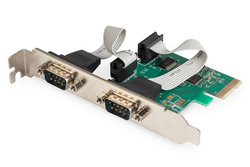
DIGITUS DS-30000-1 PCI Express Card 2x D-Sub9 serial LowProfile
| Lieske Part No. | 477510 |
|---|---|
| Mfg Part No | DS-30000-1 |
| EAN-Code | 4016032309390 |
| Manufacturer | DIGITUS |
| Here only | 23,65 EUR
28,14 EUR incl. VAT
|
Further information for DIGITUS DS-30000-1 PCI Express Card 2x D-Sub9 serial LowProfile
| General | |
| Number of serial ports | 2 |
| Interface type | RS232 |
| Connection plug | DB9 |
| Gender of connectors | male |
| UART chip | 16C950 |
| PCI Express specification | Base Specification 2.0 |
| Design | Single-chip design |
| CPU load reduction | up to 48 % |
| Scope of delivery | Serial interface card, low profile slot cover, instruction manual, driver CD |
Applications
The card is designed for use in IT systems where serial devices must be connected that do not have USB or Ethernet interfaces. Typical applications include integrating industrial control devices, measuring instruments, alarm systems, or older peripheral devices into existing computer infrastructures. The RS232 interface remains widely used in industrial automation and telecommunications, making this card a bridge between modern computers and legacy technology.
Functions and Features in Detail
The card features two serial ports with DB9 connectors, each implemented as a male socket. The interfaces are based on the UART 16C950 chip, ensuring reliable serial communication. The maximum data transfer rate is up to 128,000 bps, which is sufficient for most serial applications. The card complies with the PCI Express Base Specification 2.0, ensuring compatibility with modern motherboards. The use of a single-chip design ensures a compact form factor and reduces the number of required components.
Technology Explained Simply
Serial communication occurs via the RS232 interface, enabling a point-to-point connection between two devices. Data is transmitted bit by bit, with the card managing the transmission control. The UART chip (Universal Asynchronous Receiver/Transmitter) converts parallel data from the computer into serial signals and vice versa. The card is powered via the PCI Express bus and communicates directly with the system bus, without requiring additional power supply cables. CPU load is reduced by the integrated control logic in the chip, as data processing does not need to be fully handled by the processor.
Compatibility and Accessories
The card is compatible with systems that support a PCI Express slot. The mentioned chipsets OXPCIe952 and MCS9901 are referenced in various sources, though the information is not consistent. The card supports operating systems such as Windows 7, Vista, and XP, as stated in an English source. The delivery includes the Serial Interface Card, a Low Profile Slot Cover, an instruction manual, and a driver CD. The slot cover enables installation in computer housings with low height, which is particularly relevant in rack systems or compact PCs.
Installation and Mounting
Installation is performed by inserting the card into a free PCI Express slot on the motherboard. The Low Profile Slot Cover is mounted on the rear of the housing to ensure mechanical stability. After installation, the system is restarted, and drivers can be installed using the included CD. The instruction manual contains instructions for configuration and troubleshooting.
Operational Advantages
The card provides a reliable and cost-efficient way to connect serial devices to modern computers. The reduction in CPU load leads to better system performance, especially when multiple serial ports are used simultaneously. The use of DB9 connectors allows direct connection to a wide range of legacy devices, without requiring additional adapters or converters. The card is compact and fits in standard PC housings, including low-profile systems.

This is an offer of:
79279 Vörstetten
https://industry-electronics.com
Tel. 07666/88499-0
Fax. 07666/88499-111
Diesen Artikel finden Sie unter:
industry-electronics.com/artikel/477510

Lieske Elektronik e.K.
Reutener Str. 1079279 Vörstetten
https://industry-electronics.com
Tel. 07666/88499-0
Fax. 07666/88499-111
Diesen Artikel finden Sie unter:
industry-electronics.com/artikel/477510