
DIGITUS DN-91624S-SL-SH Patch Panel 24-Port Cat6 black
Networks > Switches > Miscellaneous
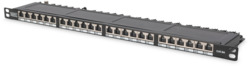
DIGITUS DN-91624S-SL-SH Patch Panel 24-Port Cat6 black
| Lieske Part No. | 599842 |
|---|---|
| Mfg Part No | DN-91624S-SL-SH |
| EAN-Code | 4016032323297 |
| Manufacturer | DIGITUS |
| Here only | 94,80 EUR
112,81 EUR incl. VAT
|
Further information for DIGITUS DN-91624S-SL-SH Patch Panel 24-Port Cat6 black
| General | |
| Number of ports | 24 |
| Port type | RJ45 |
| Degree of protection | shielded |
| Cable standard | CAT 6 |
| Power requirement | Class E |
| Frequency range | 250 MHz |
| Height | 0,5 HE |
| Mounting method | 19-inch rack |
| Colour | Black |
| Colour code | RAL 9005 |
| Plug connection | 8P8C |
| Dust protection cap | with flaps |
| Standards | ISO/IEC 11801, EN 50173 |
| Colour coding | EIA/TIA 568B |
Patch Panel is the term for a network component serving as a connection point for network cables. It is used in server rooms, data centres or IT infrastructures to structure and manage cabling. The DN-91624S-SL-SH features 24 RJ45 connectors equipped with dust protection caps to protect the contacts from contamination and extend the lifespan of the connections.
Technology explained clearly
The panel is designed for mounting in standard 19-inch enclosures with a width of 483 mm. Cabling is done via LSA strips, enabling secure and orderly cable fixation. The shielding of the panel reduces electromagnetic interference that may occur at high data rates, ensuring reliable signal transmission. Cable connections are made via 8P8C connectors following the EIA/TIA 568B standard for wire colour coding.
Compatibility and accessories
The panel is designed for use with CAT 6 network cables, which should also be shielded to fully exploit the performance features of class E. It is not specifically intended for particular brands or models of switches or routers, but serves as a universal connection point in network infrastructure. Use with other patch panels or network devices is possible as long as the physical connectors (RJ45) and cable category are compatible.
Mounting and installation
Mounting is done using the integrated mounting elements for 19-inch racks. Installation requires no additional tools or special mounting accessories, as the panel is simply inserted into the rack openings and screwed in place. The LSA strips allow for structured and secure cable fixation, ensuring orderly cabling.
Operational advantages
The high packing density of 48 ports per U reduces rack space requirements and optimizes the use of available mounting height. The dust protection caps protect contacts from contamination, increasing connection reliability. Shielding ensures low interference, which is particularly beneficial in environments with high electromagnetic noise. The use of LSA strips enables clean and orderly cable routing, simplifying maintenance and fault diagnosis.
The panel is finished in black (RAL 9005), allowing it to blend visually into typical server and network rooms. The colour is standard and meets common requirements in IT infrastructure.
Functions and equipment in detail
The panel features 24 RJ45 connectors, each equipped with a flip cover. These covers protect the contacts from dust and mechanical damage when no cable is connected. The panel’s shielding provides electromagnetic protection, maintaining signal quality at high data rates. The LSA strips enable secure and structured cable fixation, ensuring orderly cabling.
Applications
The panel is intended for use in professional IT infrastructures, particularly in server rooms, data centres, office networks, and other environments where structured and reliable network cabling is required. It is not intended for use in private households, but for use in non-private environments such as businesses, schools, or public institutions.
The panel falls under category 6 of the ElektroG, meaning it is classified as a small device in information and telecommunications technology, intended exclusively for use in non-private environments.

This is an offer of:
79279 Vörstetten
https://industry-electronics.com
Tel. 07666/88499-0
Fax. 07666/88499-111
Diesen Artikel finden Sie unter:
industry-electronics.com/artikel/599842

Lieske Elektronik e.K.
Reutener Str. 1079279 Vörstetten
https://industry-electronics.com
Tel. 07666/88499-0
Fax. 07666/88499-111
Diesen Artikel finden Sie unter:
industry-electronics.com/artikel/599842