
DIGITUS DN-19 EARTH Grounding Bar 4 Cables
Networks > Accessories > Housing
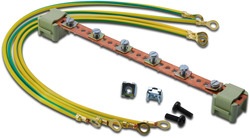
DIGITUS DN-19 EARTH Grounding Bar 4 Cables
| Lieske Part No. | 691330 |
|---|---|
| Mfg Part No | DN-19 EARTH |
| EAN-Code | 4016032142027 |
| Manufacturer | DIGITUS |
| Here only | 49,25 EUR
58,61 EUR incl. VAT
|
Further information for DIGITUS DN-19 EARTH Grounding Bar 4 Cables
| General | |
| Number of connection points | 6 |
| Material | Copper |
| Colour | Brown |
| Compatibility | 19-inch cabinets |
| Scope of delivery | earthing bar, 4 earthing cables, mounting material |
Applications
The equipotential bonding bar is primarily intended for use in IT and network enclosures, especially in environments where multiple electrical or electronic devices are installed at one location. It is used to connect all devices mounted in the enclosure via a common earthing system. This is particularly important in data centres, server rooms, or during the installation of network and communication technology, where uniform earthing reduces susceptibility to interference and increases safety. The bar is specifically suitable for all DIGITUS® 19-inch enclosures, as indicated in the product descriptions.
Functions and Features in Detail
The bar is made of copper, a material with high electrical conductivity, ensuring efficient current dissipation and minimizing resistance in the earthing system. Six connection points are integrated into the bar, each of which can be connected to an earthing cable. These earthing cables enable direct connection to the components to be earthed within the enclosure. The bar is secured to the rack's profile rails using mounting hardware, with installation carried out via draw studs. The delivery includes the equipotential bonding bar, four earthing cables, and the required mounting hardware.
Technology Explained Simply
The function of the equipotential bonding bar is based on the principle of common earthing. In an IT enclosure, potential differences between devices can arise due to different power supplies or inductive coupling. These differences can lead to interference, data loss, or even damage to the devices. The bar ensures that all connected devices are at the same electrical potential by connecting all earthing points via a common conductor. The use of copper as the material ensures high conductivity and minimizes resistance in the earthing path. The six connection points allow multiple devices to be connected, with the earthing cables directly connected to the devices.
Compatibility and Accessories
The bar is specifically designed for DIGITUS® 19-inch enclosures and conforms to the standard dimensions of these enclosure types. Installation is carried out on the profile rails, which are standard in these enclosures. The earthing cables included in the delivery are designed for direct connection to the devices.
Installation and Mounting
Mounting is carried out on the rack's profile rails using the draw studs included in the delivery. The bar is secured at the desired position, with positioning varying depending on the number and placement of the devices to be earthed. The earthing cables are connected to the six connection points on the bar and then routed to the earthing contacts of the devices installed in the enclosure. Installation requires no additional tools other than a screwdriver or suitable tool for securing the draw studs.
Operation
In operation, the equipotential bonding bar ensures stable and safe earthing of all connected components. The use of copper as the material ensures high conductivity, resulting in efficient current dissipation. The six connection points allow multiple devices to be connected, completing the earthing circuit within the enclosure. The bar reduces the risk of interference caused by potential differences and increases the safety of the installed devices. Installation is simple and does not require special skills, making it feasible even for technicians without specialized electrical knowledge.

This is an offer of:
79279 Vörstetten
https://industry-electronics.com
Tel. 07666/88499-0
Fax. 07666/88499-111
Diesen Artikel finden Sie unter:
industry-electronics.com/artikel/691330

Lieske Elektronik e.K.
Reutener Str. 1079279 Vörstetten
https://industry-electronics.com
Tel. 07666/88499-0
Fax. 07666/88499-111
Diesen Artikel finden Sie unter:
industry-electronics.com/artikel/691330