
DIGITUS DK-2933-02 LWL Patch Cable LC-LC 2m Singlemode
Cables > Data lines > Fiber Optic Patch Cables
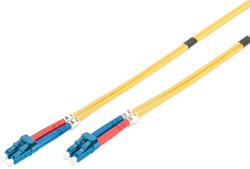
DIGITUS DK-2933-02 LWL Patch Cable LC-LC 2m Singlemode
| Lieske Part No. | 1433889 |
|---|---|
| Mfg Part No | DK-2933-02 |
| EAN-Code | 4016032248927 |
| Manufacturer | DIGITUS |
| Here only | 6,31 EUR
7,51 EUR incl. VAT
|
Further information for DIGITUS DK-2933-02 LWL Patch Cable LC-LC 2m Singlemode
| General | |
| Cable type | Fibre optic patch cable |
| Plug connection | LC/LC |
| Fibre class | OS2 |
| Fibre type | Single mode |
| Core/shield diameter | 09/125 µm |
| Number of fibres | 2 |
| Cable construction | Duplex |
| Colour | Yellow |
| Plug ferrule | Ceramics |
| Material | LSOH |
| Packaging | Single packaging in poly bag |
| Documentation | Measurement protocol |
Applications
This patch cable is designed for applications in telecommunications, rack cabling, sensor technology, and industrial environments. It is particularly suitable for networks that require high data rates over long distances, such as in data centres, factories, or when connecting network devices across multiple rooms. The use of singlemode fibre enables low attenuation and high bandwidth, which is essential for stable and reliable connections over several kilometres.
Functions and Equipment in Detail
The cable features LC connectors at both ends, equipped with ceramic ferrules. These ensure precise alignment of the fibre and minimise optical attenuation at the connection point. The use of ceramic ferrules is a standard in fibre optics to guarantee high mechanical stability and optical quality. The cable is duplex, meaning two fibres are laid in parallel to enable bidirectional data transmission.
Technology Explained Simply
The fibre class OS2 (09/125 µm) is a singlemode fibre designed for transmission distances of 10 km or more. The designation 09/125 µm describes the core and cladding diameter of the fibre. The small core width of 9 µm ensures that only a single light mode is transmitted, minimising attenuation and maximising bandwidth. The yellow colour of the cable is internationally standardised as the identifier for singlemode cabling, enabling easy identification within the network. Additionally, the cable is halogen-free (LSOH), meaning no toxic gases are released in case of fire, which is particularly advantageous in enclosed spaces such as server rooms or racks.
Compatibility and Accessories
The patch cable is compatible with devices that support LC connectors, such as switches, routers, SFP modules, or other network devices in the field of fibre cabling. It can be combined with various SFP modules, for example mini GBIC (SFP) modules for 1.25 Gbps or 10 Gbps, designed for different transmission distances. The use of LC connectors enables a compact and robust connection that integrates well into rack systems. Suitable accessories include, for example, LWL adapters, splice boxes, or tools such as crimping pliers and insertion tools, which are useful for installing and maintaining fibre networks.
Installation and Mounting
Installation is performed by simply plugging the LC connectors into the corresponding ports of the network devices. The ceramic ferrules ensure a secure and tight connection, minimising optical losses. The cable is flexible enough to be routed in standard rack systems without excessive bending stress. The length of 2 metres is sufficient for most standard applications in server rooms or between devices within a rack.
Operational Advantages
The cable offers high reliability and low attenuation, resulting in stable data transmission. The use of singlemode fibre enables high transmission rates over long distances, making it suitable for demanding networks. The halogen-free design increases safety in case of fire, and the individual packaging with test report ensures that optical properties are documented and traceable. The yellow colour simplifies identification within the network, making maintenance and troubleshooting easier.

This is an offer of:
79279 Vörstetten
https://industry-electronics.com
Tel. 07666/88499-0
Fax. 07666/88499-111
Diesen Artikel finden Sie unter:
industry-electronics.com/artikel/1433889

Lieske Elektronik e.K.
Reutener Str. 1079279 Vörstetten
https://industry-electronics.com
Tel. 07666/88499-0
Fax. 07666/88499-111
Diesen Artikel finden Sie unter:
industry-electronics.com/artikel/1433889