
DIGITUS DK-25332-02/3 LWL Patch Cable LC simplex OM3 2m
Cables > Data lines > Fiber Optic Patch Cables
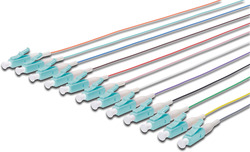
DIGITUS DK-25332-02/3 LWL Patch Cable LC simplex OM3 2m
| Lieske Part No. | 669396 |
|---|---|
| Mfg Part No | DK-25332-02/3 |
| EAN-Code | 4016032263005 |
| Manufacturer | DIGITUS |
| Here only | 24,41 EUR
29,05 EUR incl. VAT
|
Further information for DIGITUS DK-25332-02/3 LWL Patch Cable LC simplex OM3 2m
| General | |
| Cable type | LWL Pigtail |
| Connector | LC Simplex |
| Fibre class | OM3 |
| Core/shield structure | 50/125 µm |
| Construction type | Loose Buffer |
| Cable length | 2 m |
| Ferrule material | zirconia ceramic |
| Colour coding | DIN IEC 304 |
| Colour | Turquoise |
| Norm | IEC 61754-4 2002 |
Applications
These LWL pigtails are suitable for use in modern network infrastructures, particularly in environments requiring high data rates and reliability. They are used in data centres, server rooms, network switches, and other IT infrastructures where high-bandwidth multimode fibre optic cables are required. The OM3 class enables data transmission rates up to 10 Gbps over distances up to 300 metres, making them suitable for many enterprise networks and high-performance applications.
Functions and Features in Detail
The connectors comply with the standard IEC 61754-4 2002 and are equipped with a zirconia ceramic ferrule. These ceramic ferrules ensure precise alignment of the fibre optic cable and minimise optical losses at the connection point. The use of zirconia ceramic ensures high mechanical strength and long service life of the connector. The pigtails are supplied in a pack of 12 pieces, enabling the preparation of multiple connections in a single work session.
Technology Explained Simply
The term Loose Buffer describes a construction in which the fibre optic cable is housed within a flexible, protective outer sheath, shielding it from mechanical stress. In contrast to Tight Buffer cables, where the fibre is directly embedded in the protective sheath, the Loose Buffer technology offers greater flexibility and better protection, especially under frequent bending or in environments with increased mechanical stress. The OM3 class is defined for multimode fibre optic cables that provide high bandwidth and short transmission distances, typically used in local area networks (LAN) and server connections.
Compatibility and Accessories
The pigtails are compatible with standard LWL connectors of the LC type and can be used in devices that support LC connectors, such as switches, routers, or SFP modules. Suitable accessories offered in the product line include LWL splice boxes, SFP modules in various speeds and ranges, crimping pliers, and LWL adapters. These components enable flexible and scalable network design.
Installation and Mounting
Installation is carried out by directly connecting to a compatible LC connector in the network device. The colour-coded marking of the fibre sets facilitates assignment and reduces the risk of incorrect connections. The cable length of 2 metres provides sufficient clearance for cabling in standard racks and server rooms. The pigtails are designed for use in enclosed racks and environments with moderate mechanical stress.
Operational Advantages
The use of zirconia ceramic ferrules and Loose Buffer technology ensures high reliability and low optical attenuation. The colour coding according to DIN IEC 304 supports maintenance and fault diagnosis, as cables can be quickly identified. The pack of 12 pieces enables efficient preparation of multiple connections, reducing installation time.

This is an offer of:
79279 Vörstetten
https://industry-electronics.com
Tel. 07666/88499-0
Fax. 07666/88499-111
Diesen Artikel finden Sie unter:
industry-electronics.com/artikel/669396

Lieske Elektronik e.K.
Reutener Str. 1079279 Vörstetten
https://industry-electronics.com
Tel. 07666/88499-0
Fax. 07666/88499-111
Diesen Artikel finden Sie unter:
industry-electronics.com/artikel/669396