
DIGITUS DK-2532-01/3 LWL Patch Cable LC-SC OM3 1m
Cables > Data lines > Fiber Optic Patch Cables
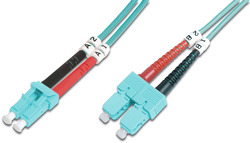
DIGITUS DK-2532-01/3 LWL Patch Cable LC-SC OM3 1m
| Lieske Part No. | 250934 |
|---|---|
| Mfg Part No | DK-2532-01/3 |
| EAN-Code | 4016032249566 |
| Manufacturer | DIGITUS |
| Here only | 3,33 EUR
3,96 EUR incl. VAT
|
Further information for DIGITUS DK-2532-01/3 LWL Patch Cable LC-SC OM3 1m
| General | |
| Cable length | 1 m |
| Fibre class | OM3 |
| Fibre type | Multi mode |
| Fibre diameter | 50/125 µm |
| Connector 1 | LC |
| Connector 2 | SC |
| Surface-mounted | Duplex |
| Outer material | LSZH |
| Plug ferrule | Ceramics |
| Colour | Turquoise |
| Product type | Fibre optic patch cable |
| Test certification | Individual test report |
Applications
This patch cable is designed for use in structured cabling systems, particularly in environments requiring high data rates and reliability. It is suitable for applications in information and telecommunications technology, for example, connecting switches, routers, servers, or other network devices within data centers, server racks, or industrial control systems. The use of multimode fibers of class OM3 enables data transfer rates up to 10 Gbps over short to medium distances, with the exact range depending on the technology and devices used.
Functions and Features in Detail
The cable has a duplex construction, meaning two fibers are laid in parallel to enable bidirectional data transmission. The connectors are equipped with ceramic ferrules, ensuring precise fiber alignment and high mechanical stability. The outer material is made of LSZH (Low Smoke Zero Halogen), which means low smoke development and no release of halogen-containing gases in case of fire. This is particularly advantageous in enclosed spaces and data centers. The turquoise marking serves for visual identification of fiber class OM3.
Technology Explained Simply
The multimode fiber OM3 enables high bandwidth and is suitable for data transmissions in the Gigabit and 10-Gigabit range. Fiber class OM3 is specifically optimized for use with 850 nm wavelengths, which is typical for modern network devices. The use of LC and SC connectors ensures universal compatibility with common network devices. The ceramic ferrules ensure clean and precise fiber alignment, improving signal quality and cable lifespan. The individual test report confirms performance characteristics and serves as documentation for quality assurance.
Compatibility and Accessories
The patch cable is compatible with devices supporting LC and SC connectors. It can be used in combination with SFP modules (mini GBIC), particularly those designed for multimode fibers, such as 1.25 Gbps modules. Suitable accessory products include fiber optic splice boxes in various configurations (e.g., 6x SC DX OM3, 12x SC DX OS2, 24x LC DX OM3) as well as crimping pliers and tools for fiber processing. Use with SFP modules requires correct wavelength and fiber class matching, with OM3 fibers needing to be combined with corresponding modules.
Installation and Mounting
Installation is performed by simply plugging the connectors into the corresponding sockets of the network devices. The connectors are designed for secure locking to prevent loose connections. The cable length of 1 meter is suitable for short connections within racks or between adjacent devices. The turquoise marking facilitates identification in cable management. The use of LSZH materials is particularly advantageous in enclosed spaces and data centers, as it causes low smoke development and no release of harmful gases in case of fire.
Operational Advantages
The cable offers high signal quality due to the use of ceramic ferrules and precise fiber alignment. Individual test certification ensures compliance with specified performance parameters. The LSZH insulation increases operational safety, especially in environments with high fire risk. The turquoise marking supports cable management and simplifies identification in the network. Compatibility with common SFP modules and network devices enables flexible integration into existing infrastructures.

This is an offer of:
79279 Vörstetten
https://industry-electronics.com
Tel. 07666/88499-0
Fax. 07666/88499-111
Diesen Artikel finden Sie unter:
industry-electronics.com/artikel/250934

Lieske Elektronik e.K.
Reutener Str. 1079279 Vörstetten
https://industry-electronics.com
Tel. 07666/88499-0
Fax. 07666/88499-111
Diesen Artikel finden Sie unter:
industry-electronics.com/artikel/250934