
DELOCK 62656 Adapter DP to VGA black
Accessories > Cable / Adapter > VGA
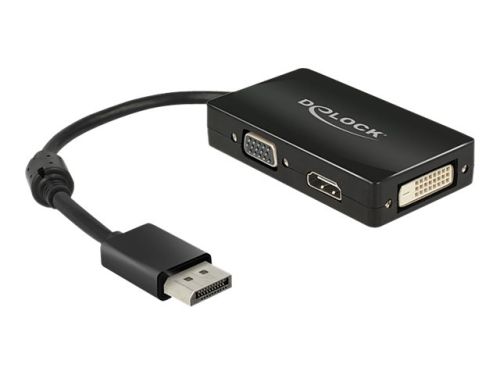
DELOCK 62656 Adapter DP to VGA black
| Lieske Part No. | 247558 |
|---|---|
| Mfg Part No | 62656 |
| EAN-Code | 4043619626564 |
| Manufacturer | DELOCK |
| Here only | 22,86 EUR
27,20 EUR incl. VAT
|
Further information for DELOCK 62656 Adapter DP to VGA black
| General | |
| Connections | 1 x DisplayPort 20-pin male connector > 1 x VGA 15-pin female connector, 1 x HDMI-A 19-pin female connector, 1 x DVI-D (Single Link) 24+1 female connector - |
| Chipset | PS8312, PTN3392 - |
| DisplayPort specification | 1.1a - |
| HDMI specification | High Speed - |
| DVI type | DVI-D (Single Link) - |
| Signal conversion | passive (level shifter) - |
| System requirement | Graphics card with DP++ output - |
| Supported resolution | 1920 x 1200 / 1080p @ 60 Hz - |
| Power consumption | ca. 100 mW |
| Ferrite core | 1 x - |
| Cable length | ca. 16 cm |
| Colour | Black - |
| Operating system compatibility | OS independent - |
| Driver installation | Not required - |
Applications
The adapter is suitable for connecting various displays and projection devices, such as PC monitors, televisions, or projectors, that feature one of the three mentioned interfaces. Since only one monitor can be connected and operated at a time, the adapter is not suitable for multi-monitor setups. It is used in environments where a system has a DisplayPort connection but does not natively support any of the desired output interfaces (VGA, HDMI, DVI). Compatibility is independent of the operating system, as no driver installation is required.
Functions and Features in Detail
The adapter is based on the chipsets PS8312 and PTN3392, which are responsible for signal conversion. Signal transmission follows the DisplayPort 1.1a specification and the High Speed HDMI specification, ensuring stable and high-quality video transmission. The maximum supported resolution is 1920 x 1200 pixels or 1080p at 60 Hz, although actual performance depends on the graphics card and connected device. The adapter's power consumption is approximately 100 mW, which is possible due to its passive design and utilization of DP++ power supply. An integrated ferrite core suppresses electromagnetic interference and ensures clean signal transmission.
Technology Explained Simply
A passive converter like this adapter operates without external power by drawing power from the DisplayPort connection. This requires the graphics card to support a DP++ output, which supplies the necessary power. Signal conversion is handled by the integrated chipsets, which transform the DisplayPort signal into the respective formats for VGA, HDMI, and DVI-D. The DVI-D socket is designed as Single Link, meaning it uses only one data channel and thus limits maximum resolution.
Compatibility and Accessories
The adapter is compatible with devices that have a DisplayPort connection and support a DP++ output. The outputs are designed for devices that accept VGA, HDMI, or DVI-D (Single Link) as input interfaces. Usage is independent of the operating system, as no driver installation is required.
Installation and Mounting
Installation is done by simply plugging the DisplayPort connector into the corresponding port on the graphics card. Then, the desired output (VGA, HDMI, or DVI-D) is connected to the target device. The cable length is approximately 16 cm without connectors, which is sufficient for compact placement inside a device or at the rear of a computer. The adapter's color is black, allowing for discreet integration into most systems.
Operational Advantages
The adapter offers a simple and cost-effective way to extend a system with multiple video outputs without requiring additional hardware or software. The passive design reduces complexity and maintenance effort, as no external power supply is needed. Operating system independence allows use in various environments regardless of the OS. The integrated interference suppression via the ferrite core ensures clean image quality.

This is an offer of:
79279 Vörstetten
https://industry-electronics.com
Tel. 07666/88499-0
Fax. 07666/88499-111
Diesen Artikel finden Sie unter:
industry-electronics.com/artikel/247558

Lieske Elektronik e.K.
Reutener Str. 1079279 Vörstetten
https://industry-electronics.com
Tel. 07666/88499-0
Fax. 07666/88499-111
Diesen Artikel finden Sie unter:
industry-electronics.com/artikel/247558