
DEHN 952113 DG S ACI 385 FM surge arrester Type 2 1p 385V
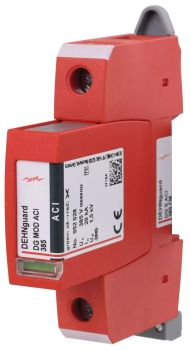
DEHN 952113 DG S ACI 385 FM surge arrester Type 2 1p 385V
| Lieske Part No. | 1865584 |
|---|---|
| Mfg Part No | 952113 |
| EAN-Code | 4013364387874 |
| Manufacturer | DEHN |
| Here only | 107,91 EUR
128,41 EUR incl. VAT
|
Further information for DEHN 952113 DG S ACI 385 FM surge arrester Type 2 1p 385V
| General | |
| Degree of protection | IP 20 |
| Maximum continuous voltage | 275 V AC |
| Nominal discharge current | 20 kA |
| Voltage protection level | ≤ 1,5 kV |
| Construction type | 1-pole, modular, pluggable |
| Additional external fuse | Not required |
| Remote alarm contact | Available |
| Fault indication | Mechanical |
| Energy coordination | in accordance with DIN EN 62305-4 |
| SPD according to EN 61643-11 / IEC 61643-11 | type 2 / class II |
| Energy coordination with terminal equipment (≤ 10 m) | type 2 + type 3 |
| Nominal voltage (a.c.) (UN) | 230 V (50 / 60 Hz) |
| Max. continuous operating voltage (AC) (UC) | 385 V (50 / 60 Hz) |
| Nominal discharge current (8/20 µs) (In) | 20 kA |
| Max. discharge current (8/20 µs) (Imax) | 40 kA |
| Voltage protection level (UP) | ≤ 1.5 kV |
| Voltage protection level at 5 kA (UP) | ≤ 1,5 kV |
| Response time (tA) | ≤ 100 ns |
| Additional external fuse necessary | not required |
| Short-circuit withstand capability (ISCCR) | 25 kArms |
| Temporary overvoltage (UT) – characteristic | 440 V / 120 min. – withstand |
| Leakage current | no leakage current |
| Operating temperature range (TU) | -40 °C ... +80 °C |
| Operating state / fault indication | green / red |
| Number of ports | 1 |
| Cross-sectional area (min.) | 1.5 mm2 solid / flexible |
| Cross-sectional area (max.) | 35 mm2 stranded / 25 mm2 flexible |
| For mounting on | 35 mm DIN rails acc. to EN 60715 |
| Enclosure material | thermoplastic, red, UL 94 V-0 |
| Place of installation | indoor installation |
| Capacity | 1 Standard DIN module, DIN 43880 |
| Approvals | KEMA |
| Type of remote signalling contact | changeover contact |
| Switching capacity (a.c.) | 250 V / 0.5 A |
| Switching capacity (d.c.) | 250 V / 0.1 A; 125 V / 0.2 A; 75 V / 0.5 A |
| Cross-sectional area for remote signalling terminals | max. 1.5 mm2 solid / flexible |
Applications
The DG S ACI 385 FM is designed for use in electrical installations in the low-voltage range, particularly in buildings equipped with a lightning protection system. It protects sensitive consumer installations, such as lighting, heating, ventilation, IT systems, or household appliances, from damage caused by overvoltages. The application is at the transitions between lightning protection zones 0B and 1, meaning it is installed at the interface between the outdoor and indoor areas to protect the power supply. The protective function is especially important in buildings highly sensitive to electrical disturbances, such as hospitals, office buildings, or apartments.
Functions and Features in Detail
The device features an integrated ACI switch/spark gap combination that activates automatically during overvoltages to divert the energy. The Thermo-Dynamic-Control monitoring system monitors the condition of the arrester and responds to overload or failure. A mechanical fault indicator allows visual inspection of the operating status without requiring additional measuring instruments. The arrester does not require an external fuse, simplifying installation and increasing reliability. An integrated remote signaling contact enables external alarm triggering in case of failure or malfunction.
Technology Explained Simply
The arrester operates on the principle of overvoltage diversion: when an overvoltage exceeding a certain threshold (protection level ≤ 1.5 kV) occurs, the arrester activates and safely diverts the excess energy to ground. The maximum continuous voltage (U_C) is 275 V AC, meaning the device is designed for operating voltages up to this value. The nominal discharge current of 20 kA indicates the maximum energy the device can safely divert without damage. The design is single-pole and modular, allowing flexible installation in standard switchboards. The width corresponds to one module unit, facilitating placement in standard switchboards.
Compatibility and Accessories
The DG S ACI 385 FM is modular and can be combined with additional protection modules to cover multiple lines or phases. Combining with additional modules allows extending the protection function to multiple circuits. The integrated ACI switch/spark gap combination is designed for use in low-voltage installations and is compatible with common switchboards. No additional fuses are required, simplifying installation. Energy coordination follows DIN EN 62305-4, ensuring compliance with standards for lightning protection and overvoltage protection.
Installation and Mounting
The arrester is mounted in standard switchboards, with mounting height and depth conforming to the switchboard specifications. Installation is done by plugging the protection modules into the base unit, enabling quick and secure installation. Wiring is done via designated terminal clamps, with polarity to be observed. The mechanical fault indicator allows visual inspection of the operating status. Installation should be carried out by qualified professionals to ensure safety and functionality.
Operational Advantages
The DG S ACI 385 FM offers high reliability thanks to integrated monitoring and fault indication. The need for an external fuse is eliminated, simplifying installation and increasing operational safety. The modular design allows flexible expansion of the protection function. The integrated remote signaling contact enables external alarm triggering in case of malfunction, facilitating maintenance and monitoring. Compliance with standards EN 61643-11 and DIN EN 62305-4 ensures conformity with applicable safety standards.

This is an offer of:
79279 Vörstetten
https://industry-electronics.com
Tel. 07666/88499-0
Fax. 07666/88499-111
Diesen Artikel finden Sie unter:
industry-electronics.com/artikel/1865584

Lieske Elektronik e.K.
Reutener Str. 1079279 Vörstetten
https://industry-electronics.com
Tel. 07666/88499-0
Fax. 07666/88499-111
Diesen Artikel finden Sie unter:
industry-electronics.com/artikel/1865584