
DEHN 943310 surge arrester Type 2
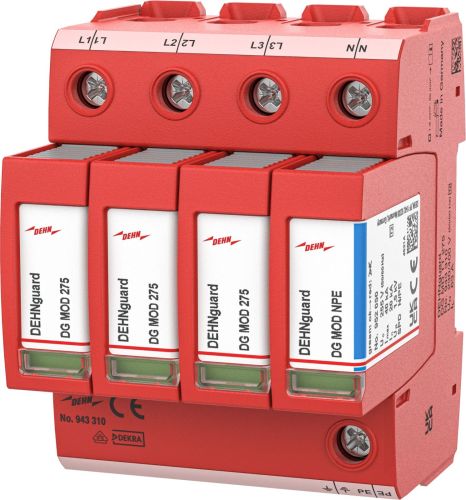
DEHN 943310 surge arrester Type 2
| Lieske Part No. | 889515 |
|---|---|
| Mfg Part No | 943310 |
| EAN-Code | 4013364522046 |
| Manufacturer | DEHN |
| Here only | 373,92 EUR
444,96 EUR incl. VAT
|
Further information for DEHN 943310 surge arrester Type 2
| Arrester use at 16.7 Hz – traction power supply systems | |
| Test voltage AC (UC) | 275 V |
| Nominal AC voltage (UN) | 230 / 400 V |
| Nominal frequency AC (fN) | 16,7 Hz |
| Technical data | |
| Energy coordination with terminal equipment (≤ 10 m) | Type 2 + type 3 |
| Nominal voltage (a.c.) (UN) | 230 / 400 V (50 / 60 Hz) |
| Max. continuous operating voltage (a.c.) [L-N] (UC) | 275 V (50 / 60 Hz) |
| Max. continuous operating voltage (a.c.) [N-PE] (UC) | 255 V (50 / 60 Hz) |
| Nominal discharge current (8/20 µs) (In) | 20 kA |
| Max. discharge current (8/20 µs) (Imax) | 40 kA |
| Combination wave [L-N] (UOC) | 20 kV |
| Combination wave [N-PE] (UOC) | 6 kV |
| Nominal load current for “V-connection” (IL) | 63 A |
| Voltage protection level [L-N]/[N-PE] (UP) | ≤ 1,5 / ≤ 1,5 kV |
| Voltage protection level [L-N]/[N-PE] at 5 kA (UP) | ≤ 1 / ≤ 1,5 kV |
| Protective conductor current (IPE) | ≤ 10 µA |
| Response time [L-N] (tA) | ≤ 25 ns |
| Response time [N-PE] (tA) | ≤ 100 ns |
| Max. mains-side overcurrent protection | 125 A gG |
| Max. mains-side overcurrent protection with “V-connection” | 63 A gG |
| Short-circuit withstand capability for max. mains-side overcurrent protection (ISCCR) | 50 kArms |
| Temporary overvoltage (TOV) [L-N] (UT) – Characteristic | 335 V / 5 sec. – Festigkeit, 440 V / 120 min. – sicherer Ausfall |
| Temporary overvoltage (TOV) [N-PE] (UT) - Characteristic | 1200 V / 200 ms – withstand |
| Operating temperature range (TU) | -40 °C ... +80 °C |
| Operating state / fault indication | grün / rot |
| Number of ports | 1 |
| Cross-sectional area (min.) | 1,5 mm2 ein- / feindrähtig |
| For mounting on | 35 mm DIN rails acc. to EN 60715 |
| Enclosure material | Thermoplastic, red, UL 94 V-0 |
| Place of installation | Indoor |
| Degree of protection | IP 20 (integrated) |
| Capacity | 4 modules, DIN 43880 Standard DIN module, DIN 43880 |

This is an offer of:
79279 Vörstetten
https://industry-electronics.com
Tel. 07666/88499-0
Fax. 07666/88499-111
Diesen Artikel finden Sie unter:
industry-electronics.com/artikel/889515

Lieske Elektronik e.K.
Reutener Str. 1079279 Vörstetten
https://industry-electronics.com
Tel. 07666/88499-0
Fax. 07666/88499-111
Diesen Artikel finden Sie unter:
industry-electronics.com/artikel/889515