
DEHN 910513 IPC P4 impulse counter
Measurement > Counter / coin, hour meter
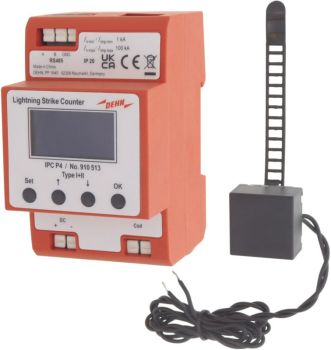
DEHN 910513 IPC P4 impulse counter
| Lieske Part No. | 604057 |
|---|---|
| Mfg Part No | 910513 |
| EAN-Code | 6942299506310 |
| Manufacturer | DEHN |
| Here only | 566,58 EUR
674,23 EUR incl. VAT
|
Further information for DEHN 910513 IPC P4 impulse counter
| General | |
| Type of device | Lightning counter |
| Function | potential-free registration of leakage currents |
Lightning counter
The IPC P4 detects the impulses generated by each discharge event of a surge protection device. These impulses are registered as counting events and can be used for later evaluation. Potential-free measurement means that there is no galvanic connection to the protection device, which increases the safety of the measuring device and the installation. Counting is performed via an optical or inductive sensor that detects the discharge impulses without any electrical current flow between the protection device and the counter.
Applications
The counter is used in electrical installations where surge protection devices are installed, for example in buildings, industrial facilities or in power supply systems. It is particularly suitable for installations where the frequency of overvoltage events must be monitored to assess the condition of protection devices and plan maintenance intervals. The application is typically in the field of operational safety and preventive maintenance.
Functions and equipment in detail
The IPC P4 features a robust construction suitable for use in industrial environments. Counting is performed via an impulse input that detects discharge events. The device stores the number of registered impulses and makes them available for evaluation. Display is via a mechanical digit roller that shows the total number of discharges. The counting is not resettable, so the total number of events is recorded over the entire operating time.
Technology explained simply
The technology of the IPC P4 is based on detecting impulses generated by each discharge event of a surge protection device. These impulses are captured by a sensor that does not establish an electrical connection to the protection device. The measurement is therefore potential-free, meaning there is no voltage between the counter and the protection device. This protects the measuring device from damage and ensures reliable measurement. Counting is performed in a mechanical counter mechanism that displays the number of impulses.
Compatibility and accessories
The IPC P4 is designed for use with surge protection devices that release discharge impulses. Compatibility is ensured if the protection device provides an impulse connection or an optical/inductive interface for counting. Installation is carried out directly on the protection device, with the exact mounting instructions corresponding to the respective connection.
Counting takes place via an impulse input that detects discharge events. The device stores the number of registered impulses and makes them available for evaluation. Display is via a mechanical digit roller that shows the total number of discharges. The counting is not resettable, so the total number of events is recorded over the entire operating time.
Mounting and installation
Mounting of the IPC P4 is done directly onto the surge protection device, connecting the impulse terminal of the protection device to the input of the counter. The connection is made via an appropriate terminal, which may vary depending on the protection device. Installation requires no special tools or additional components. Positioning should ensure the display is clearly readable and the device is protected from mechanical damage.
Advantages in operation
The use of the IPC P4 enables continuous monitoring of discharge events from surge protection devices. Potential-free measurement protects the device from damage and ensures reliable counting. The mechanical display is robust and requires no external power supply. The non-resettable counting enables permanent documentation of operating conditions. Simple mounting and maintenance reduce the effort required for plant maintenance.

This is an offer of:
79279 Vörstetten
https://industry-electronics.com
Tel. 07666/88499-0
Fax. 07666/88499-111
Diesen Artikel finden Sie unter:
industry-electronics.com/artikel/604057

Lieske Elektronik e.K.
Reutener Str. 1079279 Vörstetten
https://industry-electronics.com
Tel. 07666/88499-0
Fax. 07666/88499-111
Diesen Artikel finden Sie unter:
industry-electronics.com/artikel/604057