
DEHN 819680 lightning rod FM D40 L4700 GFK AL DBS R560 STTZN
Installation > Grounding Systems > Lightning protection material
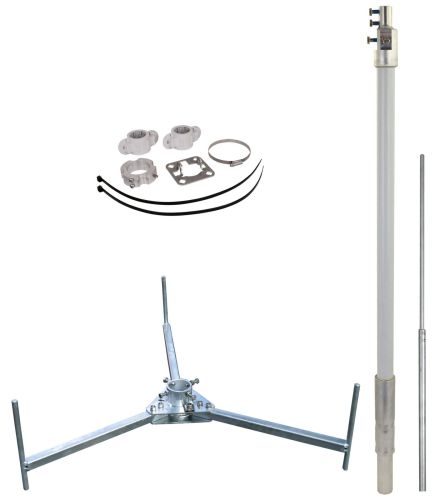
DEHN 819680 lightning rod FM D40 L4700 GFK AL DBS R560 STTZN
| Lieske Part No. | 156464 |
|---|---|
| Mfg Part No | 819680 |
| EAN-Code | 4013364494442 |
| Manufacturer | DEHN |
| Here only | 1.144,56 EUR
1.362,03 EUR incl. VAT
|
Further information for DEHN 819680 lightning rod FM D40 L4700 GFK AL DBS R560 STTZN
| General | |
| Total height | 4700 mm |
| Support tube material | GFRP/Al |
| Connection plate | Quad connection plate |
| Compatibility | HVI light plus cable |
| Roof pitch | up to max. 10° |
| Scope of delivery | Catch pole with support tube, catch rod, quad connection plate, mounting kit, tripod |
| Height | 4700 mm |
| Material of tripod | HDG steel (St/tZn) |
| Radius of tripod | 560 mm |
| Material of supporting tube | GRP / Al |
| Length of supporting tube | 1600 mm |
| Length of air-termination rod | 3000 mm |
| Material of air-termination rod | AlMgSi |
| Standard | DIN EN IEC 62561-8 (VDE 0185-561-8) |
Applications
The lightning rod mast is used in the field of lightning protection, particularly for the installation of HVI light plus conductors on flat roofs. It is suitable for buildings requiring effective lightning diversion and enables secure fastening of the conductor. The construction is designed for outdoor use, with materials and design meeting requirements for durability and weather resistance.
Functions and Equipment in Detail
The set includes a four-way connection plate, specifically developed for the HVI light plus conductor. This plate enables a secure and reliable connection between the conductor and the lightning rod mast. Additionally, a mounting kit is included, supporting the installation of the conductor onto the connection plate. The tripod base ensures stable placement of the mast on the roof, with the legs providing sufficient base area to stabilize the system even under wind load.
Technology Explained Simply
The lightning rod mast consists of a support tube made of glass-fiber-reinforced plastic (GFK) and aluminum (Al). This material combination offers high mechanical strength while being lightweight, facilitating handling and installation. The GFK component provides high corrosion resistance, while aluminum adds additional stability and thermal conductivity. The integrated lightning rod serves as the endpoint of the conductor and ensures safe diversion of lightning current.
Compatibility and Accessories
The lightning rod mast is specifically designed for use with the HVI light plus conductor. The four-way connection plate is directly designed for this conductor, ensuring a compatible and secure connection. The mounting kit is also matched to the HVI light plus conductor, enabling a firm and durable installation. The tripod base is standard accessory for mast installation and is included in the delivery scope.
Installation and Mounting
Installation is carried out on flat roofs with a slope of up to 10°. The tripod base is first positioned and secured on the roof, with the legs providing a stable foundation. Subsequently, the support tube is inserted into the tripod, and the four-way connection plate is mounted at the top end of the mast. The HVI light plus conductor is attached to the connection plate, with the mounting kit ensuring a secure connection. The total height of 4700 mm is achieved by combining the support tube and the lightning rod.
Operational Advantages
The lightning rod mast provides a reliable and low-maintenance solution for lightning protection installation on flat roofs. The materials ensure long service life and high resistance to environmental influences. The integrated lightning rod ensures safe diversion of lightning current, while the four-way connection plate enables a stable connection to the conductor. The tripod base ensures secure placement, keeping the system stable even under wind load. The total height of 4700 mm provides sufficient elevation of the conductor above the roof, ensuring effective lightning diversion.

This is an offer of:
79279 Vörstetten
https://industry-electronics.com
Tel. 07666/88499-0
Fax. 07666/88499-111
Diesen Artikel finden Sie unter:
industry-electronics.com/artikel/156464

Lieske Elektronik e.K.
Reutener Str. 1079279 Vörstetten
https://industry-electronics.com
Tel. 07666/88499-0
Fax. 07666/88499-111
Diesen Artikel finden Sie unter:
industry-electronics.com/artikel/156464