
DEHN 105186 FS T D50 5500 6500 AL telescopic capture rod Al D
Installation > Grounding Systems > Lightning protection material
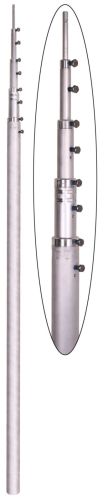
DEHN 105186 FS T D50 5500 6500 AL telescopic capture rod Al D
| Lieske Part No. | 641205 |
|---|---|
| Mfg Part No | 105186 |
| EAN-Code | 4013364481435 |
| Manufacturer | DEHN |
| Here only | 584,53 EUR
695,59 EUR incl. VAT
|
Further information for DEHN 105186 FS T D50 5500 6500 AL telescopic capture rod Al D
| General | |
| Maximum length | 6500 mm |
| Diameter at lower end | 50 mm |
| Diameter of catch tip | 10 mm |
| Application range | roof-mounted installations |
| Total length | 6500 mm |
| Air-termination tip (Ø length) | 10-1000 mm |
| Air-termination mast (Ø length) | 50/40/30/20-5500 mm |
| Transport length | 1650 mm |
| Mast segments | 5 |
| Foot Ø | 50 mm |
| Max. free length with air-termination rod | 5200 mm |
| Clamping length | 1000 mm and 1300 mm |
| Max. gust wind speed (Air-termination tip Ø10 mm, L = 0 mm) | 189 km/h |
| Max. gust wind speed (Air-termination tip Ø10 mm, L = 500 mm) | 172 km/h |
| Max. gust wind speed (Air-termination tip Ø10 mm, L = 1,000 mm) | 149 km/h |
| Number of fixings | 2-3 |
| Material of air-termination rod | Al |
| Standard | DIN EN 62561-(1+2) |
Telescopic lightning rod
The rod consists of five interlocking segments that can be extended to a total length of 6500 mm. The diameter starts at 50 mm at the lower end and tapers continuously to 10 mm at the tip. This design ensures stable mounting and high flexibility when adapting to specific roof geometries. The telescopic construction enables easy handling and adjustment to various height requirements.
Application areas
The lightning rod is specifically designed for use on roofs, where technical installations or structures are exposed to increased lightning strike risk. It protects, for example, antennas, satellite dishes, ventilation systems, or other metallic structures that could act as lightning conductors. Installation is carried out on load-bearing substrates such as walls or stands, with flexible mounting options to accommodate various installation scenarios.
Functions and equipment in detail
The rod is manufactured as lightning protection material and serves as a lightning rod within a lightning protection system. The tapering of the diameter from 50 mm at the lower end to 10 mm at the tip ensures optimal guidance of the lightning current and minimizes the risk of spark overvoltage. The five segments are dimensioned to slide securely into each other and maintain the desired length stably. The surface is made of aluminium, ensuring good electrical conductivity and corrosion resistance.
Technology explained simply
The function of the lightning rod is based on the principle of lightning diversion: it captures a lightning strike and diverts the high current through a grounded system. The telescopic construction allows the rod to be adjusted to the height of the object to be protected without requiring additional parts. The tapering of the rod ensures that the tip extends further into the air, thereby increasing the probability of a direct strike. The choice of aluminium material ensures sufficient conductivity and resistance to weather influences.
Compatibility and accessories
The lightning rod is intended for mounting on walls, in stands, or on other load-bearing structures. Its use requires an appropriate mounting method, which varies depending on the substrate (e.g. masonry, metal, wood). Compatibility with other lightning protection components is ensured as long as an electrical connection to the grounding system is established.
Mounting and installation
Installation is carried out by securing the rod to a load-bearing substrate, where it is extended to the desired length and fixed. Mounting options are diverse and include, for example, wall mounting or stand mounting. The rod must be securely fastened to prevent any movement or displacement during a lightning strike.
Advantages in operation
The telescopic design offers high adaptability to different roof constructions and object heights. The use of aluminium ensures long-lasting and low-maintenance performance, even under weather-exposed conditions. The simple installation and stable construction reduce installation time and increase the reliability of the lightning protection system. The lightning rod is thus an efficient solution for protecting rooftop installations from direct lightning strikes.

This is an offer of:
79279 Vörstetten
https://industry-electronics.com
Tel. 07666/88499-0
Fax. 07666/88499-111
Diesen Artikel finden Sie unter:
industry-electronics.com/artikel/641205

Lieske Elektronik e.K.
Reutener Str. 1079279 Vörstetten
https://industry-electronics.com
Tel. 07666/88499-0
Fax. 07666/88499-111
Diesen Artikel finden Sie unter:
industry-electronics.com/artikel/641205