
D-Link DGS-1008D/E Switch 8xGBit unmanaged
Networks > Switches > up to 8 ports
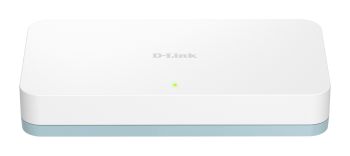
D-Link DGS-1008D/E Switch 8xGBit unmanaged
| Lieske Part No. | 805305 |
|---|---|
| Mfg Part No | DGS-1008D/E |
| EAN-Code | 0790069252747 |
| Manufacturer | D-Link |
| Here only | 24,50 EUR
29,15 EUR incl. VAT
|
Further information for D-Link DGS-1008D/E Switch 8xGBit unmanaged
| Data transmission | |
| Switching capacity | 16 Gbit/s |
| MAC address table | 4000 entries |
| Jumbo frames | 9216 |
| Packet forwarding rate (1 Gbps) | 1488000 pps |
| Packet forwarding rate (100 Mbps) | 148800 pps |
| Packet forwarding rate (10 Mbps) | 14880 pps |
| Packet buffer memory | 0.128 MB |
| Store-and-forward | |
| Jumbo frames support | |
| Design | |
| Product colour | White |
| Housing material | Plastic |
| Rack mounting | |
| LED indicators | |
| Logistics data | |
| Harmonized System (HS) code | 85176990 |
| Management features | |
| Switch type | Unmanaged |
| Quality of Service (QoS) support | |
| Network | |
| Networking standards | IEEE 802.1p, IEEE 802.3, IEEE 802.3ab, IEEE 802.3az, IEEE 802.3u |
| Ethernet LAN data rates | 10,100,1000 Mbit/s |
| 10G support | |
| Full duplex | |
| Auto MDI/MDI-X | |
| MAC address auto-learning supported | |
| Operational conditions | |
| Operating temperature (T-T) | 0 - 40 °C |
| Storage temperature (T-T) | -10 - 70 °C |
| Operating relative humidity (H-H) | 10 - 90% |
| Storage relative humidity (H-H) | 5 - 90% |
| Packaging content | |
| Manual | |
| Performance | |
| Mean time between failures (MTBF) | 1046472 h |
| Ports & interfaces | |
| Basic switching RJ-45 Ethernet ports quantity | 8 |
| Basic switching RJ-45 Ethernet ports type | Gigabit Ethernet (10/100/1000) |
| Power | |
| DC input voltage | 5 V |
| Input current | 1 A |
| Power consumption (max) | 2.55 W |
| Power over Ethernet (PoE) | |
| Power over Ethernet (PoE) | |
| Weight & dimensions | |
| Width | 138 mm |
| Depth | 85 mm |
| Height | 34 mm |
| Weight | 400 g |

This is an offer of:
79279 Vörstetten
https://industry-electronics.com
Tel. 07666/88499-0
Fax. 07666/88499-111
Diesen Artikel finden Sie unter:
industry-electronics.com/artikel/805305

Lieske Elektronik e.K.
Reutener Str. 1079279 Vörstetten
https://industry-electronics.com
Tel. 07666/88499-0
Fax. 07666/88499-111
Diesen Artikel finden Sie unter:
industry-electronics.com/artikel/805305