
Cimco 150232 solder flux 100 g
Tools > Soldering Tools > Soldering Accessories
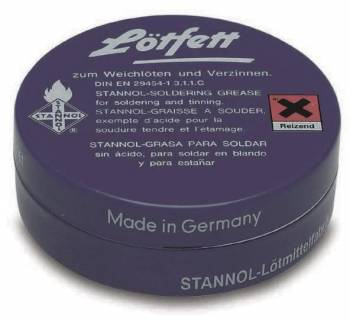
Cimco 150232 solder flux 100 g
| Lieske Part No. | 666399 |
|---|---|
| Mfg Part No | 150232 |
| EAN-Code | 4021103502327 |
| Manufacturer | Cimco |
| Here only | 5,40 EUR
6,43 EUR incl. VAT
|
Further information for Cimco 150232 solder flux 100 g
| General | |
| Product type | Soldering flux |
| Norm | DIN EN 29454-1 3.1.1.C |
| Application area | soft soldering of galvanised steel and tinned steel, tinning of copper and brass |
| Not suitable for | electrical and electronics |
| Composition | Contains zinc chloride, corrosive |
Applications
This soldering grease is mainly used in metal construction, body and sheet metal work, as well as in sanitary and heating technology, where the joining of sheet metal materials by soft soldering is required. It serves as a flux that removes oxide layers from the metal surfaces to be joined, enabling a clean, tight solder joint. Application is done by applying the grease to the surfaces to be soldered, where the grease becomes active upon heating and cleans the solder joint.
Functions and Equipment in Detail
The product is formulated as a liquid, paste-like grease that can be easily applied to metallic surfaces. It contains zinc chloride, which acts as an active flux to reduce oxides and improve the wettability of the solder joint. Use is restricted to non-electronic applications, as the corrosive zinc chloride can cause corrosion and malfunction when in contact with electrical components. The packaging is filled in 100-g portions, which is sufficient for small to medium soldering tasks.
Technology Explained Simply
Soldering grease serves as a flux that melts at soldering temperature and breaks down oxide layers on metal surfaces. This exposes a clean, metallic surface, enabling optimal wetting by the solder metal. The zinc chloride in the grease is responsible for this cleaning effect, but it is not suitable for sensitive electronic systems, as it cannot be fully removed after soldering and has long-term corrosive effects. The standard DIN EN 29454-1 3.1.1.C defines the requirements for the chemical composition and performance of the flux to ensure a reliable solder joint.
Compatibility and Accessories
The soldering grease is compatible with sheet steel, tinplate, copper, and brass. It is used in conjunction with soft solder alloys such as tin-lead or tin-zinc alloys. It is not intended for use with electronic components or in electrical engineering.
Installation and Mounting
Application is done by applying the grease to the metal surfaces to be joined. It is applied before the soldering process, with a thin, even layer being sufficient. Upon heating, the grease melts and acts as a flux. After soldering, mechanical cleaning of the solder joint is recommended to remove excess grease. The product is used without additional tools or aids.
Operational Advantages
The soldering grease provides reliable cleaning of solder surfaces and improves wettability, resulting in a tight, stronger solder joint. Use in accordance with DIN EN 29454-1 3.1.1.C ensures standardised quality. The 100-g packaging is suitable for targeted applications and prevents waste. Clear labelling of application areas protects against misuse in sensitive areas such as electronics.

This is an offer of:
79279 Vörstetten
https://industry-electronics.com
Tel. 07666/88499-0
Fax. 07666/88499-111
Diesen Artikel finden Sie unter:
industry-electronics.com/artikel/666399

Lieske Elektronik e.K.
Reutener Str. 1079279 Vörstetten
https://industry-electronics.com
Tel. 07666/88499-0
Fax. 07666/88499-111
Diesen Artikel finden Sie unter:
industry-electronics.com/artikel/666399