
Cimco 111280 Phase Tester 100-250 VAC
Measurement > Voltage Measurement
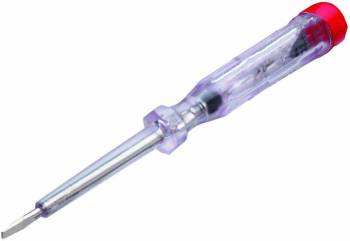
Cimco 111280 Phase Tester 100-250 VAC
| Lieske Part No. | 471094 |
|---|---|
| Mfg Part No | 111280 |
| EAN-Code | 4021103112809 |
| Manufacturer | Cimco |
| Here only | 2,89 EUR
3,44 EUR incl. VAT
|
Further information for Cimco 111280 Phase Tester 100-250 VAC
| General | |
| Operating voltage | without internal power supply, uses voltage of test object |
| Voltage measurement range | 100 V |
| Type of test | 1-pole |
| Voltage indication | Glow lamp |
| Blade length | 65 mm |
| Blade width | 3,0 mm |
| Total length | 140 mm |
| Measuring circuit category | without power supply from the test object (without battery) |
| VDE approval | |
| Continuity test | |
| Data hold | |
| Load switchable | |
| Indication of direction of field rotation | |
| Resistance measurement | |
| Contact less voltage detection | |
| Background lighting LC-indication | |
| Test probe protection | |
| Measuring point lightning | |
| Usable at precipitation | |
| Single-phase indication | |
Applications
The phase tester is used in electrical engineering to check for the presence of voltage in electrical lines. It is particularly suitable for work on low-voltage installations in the range of 100 V to 250 V alternating current. The device is used to identify individual phase conductors in three-phase networks, with indication provided by a neon lamp. VDE approval ensures compliance with safety standards for electrical measuring instruments and enables professional use.
Functions and Equipment in Detail
Voltage indication is provided by a neon lamp, which lights up when connected to a live conductor. The device operates without internal power supply, i.e. without batteries, and uses the voltage of the object being tested for operation. It is designed for single-pole testing, making it suitable for identifying individual phase conductors in a network. The measurement circuit category is defined as 'without power supply from the test object', meaning the device does not require an additional energy source. It does not have a switchable load, no peak value memory (Data Hold), and no rotating field direction indicator. The function of non-contact voltage detection is not available.
Technology Explained Simply
The phase tester operates on the basis of inductive voltage detection. When touching a live conductor, a small current flows through the device, sufficient to activate the neon lamp. The neon lamp lights up as soon as a voltage in the range of 100 V to 250 V alternating current is applied. The blade length of 65 mm and width of 3.0 mm ensure safe and precise contact with the conductors. The impact-resistant plastic handle protects the user from mechanical damage and enables safe handling. The device is not intended for use in rainy conditions, as it does not have special protection against moisture.
Compatibility and Accessories
The device can be used in combination with other tools for electricians, especially with insulated screwdriver sets and voltage testers. Suitable accessories include, for example, insulated screwdrivers in various sizes, an electrician's tool set, and a phase tester with different dimensions. Combining it with insulated tools increases safety when working on electrical installations. The use of insulating tape can be helpful for marking conductors.
Mounting and Installation
The phase tester is connected directly to the conductors to be tested. No mounting or installation is required, as it is a hand-held measuring device. Use involves simply placing the test tip against the conductor. VDE approval ensures the device meets the required safety standards. It is important that the device is only used in dry environments, as it is not designed for use in rainy conditions.
Operational Advantages
The phase tester offers a fast and reliable method for voltage detection in electrical installations. The clear indication via the neon lamp allows immediate reaction to the presence of voltage. The impact-resistant plastic handle ensures long service life and safe handling. VDE approval ensures compliance with safety standards and enables professional use. The device is light, compact, and easy to operate, making it particularly suitable for daily use in the electrical trade.
Protection Rating
The device is not intended for outdoor use in rainy conditions. It does not have special protection against moisture, so it should only be used in dry indoor environments.
Operating Voltage
It uses the voltage of the object being tested for operation. The voltage measurement range is between 100 V and 250 V alternating current. The neon lamp lights up as soon as a voltage in this range is applied.
Test Type
The test type is single-pole, meaning the device is designed for identifying individual phase conductors in a network. It is not suitable for testing rotating field direction or for measuring resistance. The single-pole phase indication enables identification of individual conductors in a three-phase system.
Weight and Dimensions
The device has a total length of 140 mm, a width of 20 mm, and a height of 16 mm. The weight is 0.02 kg, making it light and easy to handle. The dimensions are designed so that the device can be comfortably held in hand and used during work on electrical installations.
Approval
The device is VDE-approved, confirming compliance with safety standards for electrical measuring instruments. The approval ensures the device is suitable for professional use in the electrical trade. VDE approval is an important factor for the safety and reliability of the device.
Display
Voltage indication is provided by a neon lamp, which lights up when connected to a live conductor. The display is clear and immediate, enabling quick reaction to the presence of voltage. There is no backlighting for the display, so the neon lamp may be difficult to see in dark environments.
Usage
The phase tester is intended for use in electrical installations in the range of 100 V to 250 V alternating current. It is used for identifying phase conductors and checking voltage in lines. Use involves directly placing the test tip against the conductor. It is important that the device is only used in dry environments, as it is not designed for use in rainy conditions.
Accessories
Suitable accessories include insulated screwdrivers in various sizes, an electrician's tool set, and a phase tester with different dimensions. Combining it with insulated tools increases safety when working on electrical installations. The use of insulating tape can be helpful for marking conductors.
Safety
VDE approval ensures compliance with safety standards for electrical measuring instruments. The device is suitable for professional use in the electrical trade. It is important that the device is only used in dry environments, as it is not designed for use in rainy conditions. The use of insulated tools increases safety when working on electrical installations.

This is an offer of:
79279 Vörstetten
https://industry-electronics.com
Tel. 07666/88499-0
Fax. 07666/88499-111
Diesen Artikel finden Sie unter:
industry-electronics.com/artikel/471094

Lieske Elektronik e.K.
Reutener Str. 1079279 Vörstetten
https://industry-electronics.com
Tel. 07666/88499-0
Fax. 07666/88499-111
Diesen Artikel finden Sie unter:
industry-electronics.com/artikel/471094