
Cimco 101904 Crimping Pliers Pin Crimping 0.5–16 mm²
Tools > Pliers > Crimping pliers
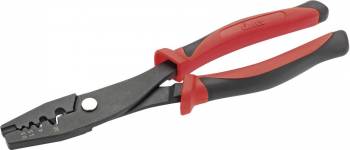
Cimco 101904 Crimping Pliers Pin Crimping 0.5–16 mm²
| Lieske Part No. | 514668 |
|---|---|
| Mfg Part No | 101904 |
| EAN-Code | 4021103019047 |
| Manufacturer | Cimco |
| Here only | 52,10 EUR
62,00 EUR incl. VAT
|
Further information for Cimco 101904 Crimping Pliers Pin Crimping 0.5–16 mm²
| General | |
| Product type | hand crimping tool |
| Pressing process | Arbour clamping |
| Conductor cross-section capacity | 0,5–16 mm² |
| Compatibility | insulated and non-insulated ferrules, twin ferrules |
| Crimp length | 230 mm |
Applications
The crimping tool is primarily used in the field of electrical installation, where conductors are connected with wire end ferrules. It is suitable for work on high-current installations, in building technology, as well as for mounting connection elements in enclosures and controls. The ability to process insulated and non-insulated ferrules allows for flexible application, regardless of the insulation type of the conductor. The tool is also designed for twin wire end ferrules, which are used to connect multiple conductors within a single ferrule body.
Functions and Equipment in Detail
The tool operates on the principle of pin crimping, in which a crimp pin is inserted into the wire end ferrule to deform it mechanically and thus create a secure connection to the conductor. The crimping tool is designed as a hand tool, meaning that force is applied manually via the lever arms. The crimping length is 230 mm, providing sufficient leverage for processing the specified cross-sections. The tool is designed for use with wire end ferrules in the range of 0.5 to 16 mm², with exact fit ensured by the specific geometry of the crimp jaws.
Technology Explained Simply
Pin crimping is a method in which the wire end ferrule is deformed by a cylindrical crimp pin inserted into the ferrule. The ferrule is compressed at the edges, securely gripping the conductor. This technique ensures high mechanical strength and reliable electrical conductivity. The crimping tool is designed to apply the required crimping force for various cross-sections in the range of 0.5 to 16 mm². The crimp jaws are specially shaped to precisely deform the wire end ferrules without damaging them or over-crimping.
Compatibility and Accessories
The crimping tool is compatible with wire end ferrules in the cross-section range of 0.5 to 16 mm², including insulated, non-insulated, and twin wire end ferrules. As complementary accessories, the crimping tool 101906 is offered, which is also designed for pin crimping and covers cross-sections from 0.5 to 2.5 mm². This complements the tool portfolio for smaller applications. The use of appropriate wire end ferrules is essential to ensure a secure and durable connection.
Mounting and Installation
Mounting is performed manually by inserting the conductor into the wire end ferrule, then inserting the ferrule into the crimp jaws of the tool, and executing the crimping process by closing the tool. The crimp jaws are designed to precisely position the ferrule and apply the required crimping force. It is important to use the correct crimp jaw for the respective cross-section to achieve an optimal connection. The tool requires no additional tools or aids for the crimping process.
Advantages in Operation
The hand crimping tool provides a reliable and precise connection, ensuring electrical conductivity and mechanical strength. Manual operation allows for controlled application of crimping force, preventing over-crimping or under-crimping. The ability to process insulated and non-insulated ferrules as well as twin wire end ferrules expands the range of applications. The robust construction ensures long service life and high durability in daily use.

This is an offer of:
79279 Vörstetten
https://industry-electronics.com
Tel. 07666/88499-0
Fax. 07666/88499-111
Diesen Artikel finden Sie unter:
industry-electronics.com/artikel/514668

Lieske Elektronik e.K.
Reutener Str. 1079279 Vörstetten
https://industry-electronics.com
Tel. 07666/88499-0
Fax. 07666/88499-111
Diesen Artikel finden Sie unter:
industry-electronics.com/artikel/514668