
Chauvin Arnoux XR43-BA4 reference electrode 4 mm connector
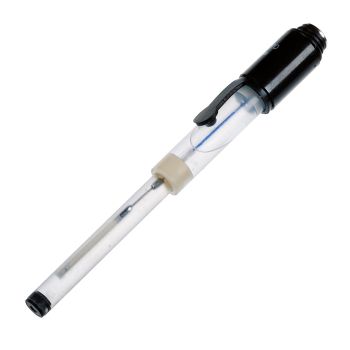
Chauvin Arnoux XR43-BA4 reference electrode 4 mm connector
| Lieske Part No. | 1182003 |
|---|---|
| Mfg Part No | XR43-BA4 |
| EAN-Code | 3663653007238 |
| Manufacturer | Chauvin Arnoux |
| Here only | 250,80 EUR
298,45 EUR incl. VAT
|
Further information for Chauvin Arnoux XR43-BA4 reference electrode 4 mm connector
The XR43-BA4 is a reference electrode of the mercury sulfate (Hg/Hg₂SO₄) type, manufactured by Chauvin Arnoux, and is specifically designed for redox potential measurements in systems with separate electrodes. It is used in combination with a measuring electrode (e.g. BAG1 or XAG1) to precisely determine the redox potential of a solution. The electrode features a PVC body that protects the sensitive internal structure, and is equipped with a porous ceramic diaphragm that allows the reference electrolyte to exit in a controlled manner, preventing uncontrolled leakage. Internally, it contains a glass tube in which a drop of mercury and a drop of mercury sulfate are placed on a platinum wire. The reference electrolyte consists of a saturated potassium sulfate solution (K₂SO₄), which ensures the stability of the potential.
Applications
The XR43-BA4 is particularly used in argentometric dosing applications, where the use of a calomel electrode is not possible due to the reaction of silver ions (Ag⁺) with chloride ions (Cl⁻) forming a silver chloride precipitate (AgCl). In such cases, the mercury sulfate reference electrode provides a stable and reliable reference, ensuring measurement accuracy. It is suitable for measurements in laboratory and field applications, especially when experimental conditions require an alternative reference electrode.
Functions and Equipment in Detail
The electrode provides a constant reference potential that serves as a baseline for measuring redox potential. The ceramic connection ensures controlled diffusion of the electrolyte, enabling uniform and reproducible measurements. The PVC body protects the sensitive internal components from mechanical damage and chemical influences. Connection is made via a 4 mm banana plug, ensuring secure and easy attachment to measuring devices. The electrode is designed for use in solutions that do not react with mercury, and requires careful handling due to the toxicity of mercury.
Technology Explained Simply
Redox potential (ORP) describes the ability of a solution to accept or donate electrons. Measurement is performed by determining the potential difference between a measuring electrode and a reference electrode. The XR43-BA4 functions as the reference electrode, providing a stable, unchanging potential that serves as the zero point for the measurement. The ceramic diaphragm allows controlled ion movement, enabling the electrode to maintain its function over extended periods. The saturated potassium sulfate solution inside ensures a constant ion concentration, which is crucial for potential stability.
Compatibility and Accessories
The XR43-BA4 is specifically designed for use with measuring electrodes of type BAG1 or XAG1. It is part of a system with separate electrodes, which is particularly preferred in educational applications or when the service life of the measuring electrode differs from that of the reference electrode.
Mounting and Installation
The electrode is immersed directly into the solution to be measured, with care taken to protect the PVC body and ceramic diaphragm from mechanical damage. Connection is made via the 4 mm banana plug to the measuring device. Proper installation requires that the electrode is fully immersed in the solution and that the diaphragm is not damaged. The electrode is not intended for use in aggressive or oxidizing media that could react with mercury.
Operational Advantages
The XR43-BA4 provides a stable and reproducible reference for redox measurements, particularly in applications where calomel electrodes are unsuitable. The use of a PVC body and ceramic diaphragm ensures long service life and reliable measurement results. The simple connection via the 4 mm banana plug facilitates integration into existing measurement systems. The electrode is suitable for laboratory and field applications, although handling requires special caution due to the toxicity of mercury.

This is an offer of:
79279 Vörstetten
https://industry-electronics.com
Tel. 07666/88499-0
Fax. 07666/88499-111
Diesen Artikel finden Sie unter:
industry-electronics.com/artikel/1182003

Lieske Elektronik e.K.
Reutener Str. 1079279 Vörstetten
https://industry-electronics.com
Tel. 07666/88499-0
Fax. 07666/88499-111
Diesen Artikel finden Sie unter:
industry-electronics.com/artikel/1182003