
Chauvin Arnoux P03652905 surface temperature sensor -50°C to +500°C
Measurement > Measuring Accessories > Probes
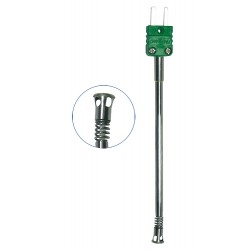
Chauvin Arnoux P03652905 surface temperature sensor -50°C to +500°C
| Lieske Part No. | 978751 |
|---|---|
| Mfg Part No | P03652905 |
| EAN-Code | 3760171415047 |
| Manufacturer | Chauvin Arnoux |
| Here only | 331,20 EUR
394,13 EUR incl. VAT
|
Further information for Chauvin Arnoux P03652905 surface temperature sensor -50°C to +500°C
| General | |
| Tolerance class | 2 |
| Sensor diameter at contact | 8,5 mm |
Applications
This sensor is suitable for surface temperature measurements in industrial and laboratory settings. It is particularly appropriate for applications requiring temperature measurement on solid, flat, or slightly curved surfaces. The combination of spring contact and compensated miniature plug enables flexible integration into existing measurement systems. It is typically used with thermometers of models C.A 1821, C.A 1822, TK 2000, TK 2002, and the data logger L642. With an adapter, the sensor can also be operated with multimeters.
Functions and Equipment in Detail
The sensor operates on the principle of the K-thermocouple, based on the Seebeck effect, generating an electrical voltage proportional to the temperature difference between the two ends of the thermocouple. The tolerance class 2 ensures defined measurement accuracy sufficient for many industrial applications. The response time at 63 % is 1 second, enabling rapid reaction to temperature changes. The sensor length of 15 cm provides sufficient space for mounting and cabling, while the diameter of 5 mm (8.5 mm at contact point) ensures compact and even surface contact.
Technology Explained Simply
The sensor uses a K-thermocouple made of two different metals (e.g. Chromel and Alumel) joined at one end. A small electrical voltage is generated when there is a temperature difference between the measurement point and the reference point, which is converted into a temperature reading. The compensated miniature plug ensures that the temperature at the connection point is taken into account to minimise measurement errors. The spring in the contact area provides constant pressure to ensure stable thermal coupling.
Compatibility and Accessories
The sensor is compatible with thermometers C.A 1821, C.A 1822, TK 2000, TK 2002, and the data logger L642. Use with multimeters is possible via an adapter. Thermocouple sensors of classes I/II are interchangeable, enabling flexible use and maintenance. As an alternative, the surface sensor SK4 250°C is available, featuring a measurement range of 0 °C to 250 °C and an identical response time of 1 second at 63 %. It includes a stainless steel sheath and a Teflon base plate.
Mounting and Installation
Mounting is done by direct contact of the sensor surface with the surface to be measured. The spring contact ensures secure and even contact. Connection to the measuring device is made via the compensated miniature plug. It is essential to ensure the contact surface is clean and free from contamination to avoid measurement errors. The sensor length of 15 cm allows for flexible positioning and cabling.
Operational Advantages
The sensor offers fast response time, high measurement accuracy due to tolerance class 2, and robust construction for industrial environments. The combination of spring contact and compensated plug ensures reliable and reproducible measurements. Compatibility with various measuring devices increases operational flexibility. The product is delivered with user instructions to support correct handling and installation.
Scope of Delivery
The scope of delivery includes 1 x K-thermocouple sensor (surface sensor with spring contact) and 1 x user instructions.
Measurement Range and Operating Temperature
The sensor is designed for a measurement range of -50 °C to 450 °C. The actual operating temperature range is therefore -50 °C to 450 °C.
Connection and Plug Connection
The connection is made via a compensated miniature plug, ensuring precise and stable connection with compatible measuring devices. The compensation accounts for the temperature at the connection point to minimise measurement errors.
Materials and Construction
The sensor construction includes a spring contact that expands to 8.5 mm upon contact. The sensor diameter is 5 mm.

This is an offer of:
79279 Vörstetten
https://industry-electronics.com
Tel. 07666/88499-0
Fax. 07666/88499-111
Diesen Artikel finden Sie unter:
industry-electronics.com/artikel/978751

Lieske Elektronik e.K.
Reutener Str. 1079279 Vörstetten
https://industry-electronics.com
Tel. 07666/88499-0
Fax. 07666/88499-111
Diesen Artikel finden Sie unter:
industry-electronics.com/artikel/978751