
Chauvin Arnoux P01710021 conductivity meter lab analog output
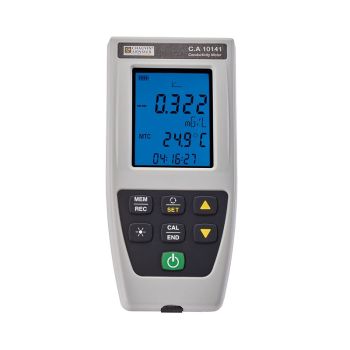
Chauvin Arnoux P01710021 conductivity meter lab analog output
| Lieske Part No. | 1142707 |
|---|---|
| Mfg Part No | P01710021 |
| EAN-Code | 3663653008983 |
| Manufacturer | Chauvin Arnoux |
| Here only | 774,00 EUR
921,06 EUR incl. VAT
|
Further information for Chauvin Arnoux P01710021 conductivity meter lab analog output
The Chauvin Arnoux CA 10141E is a laboratory conductivity meter developed for precise electrochemical measurements in research, education, environmental protection, food industry, agriculture, and chemical industry. It measures electrical conductivity (EC), total dissolved solids (TDS), specific resistance, salt content, and sample temperature. The device generation is designed for laboratory use, features a compact design, and is particularly robust due to its shock-resistant housing. The large, multi-line LCD display with backlighting ensures clear readability of measurement values under all lighting conditions. Additionally, signal stability, battery charge level, sample temperature, and measurement time are displayed simultaneously.
Applications
The CA 10141E is suitable for fixed and mobile measurements in the laboratory. It is used in educational institutions, research laboratories, environmental analyses, the food industry, agriculture, and the chemical industry. The devices are compatible with interfaces for computer-based experiments and enable integration into teaching and research environments. Connection to Regressi and Graph 2D software via the µUSB port supports data-based analyses and documentation of experiments.
Functions and Equipment in Detail
The device features a large internal memory capable of storing up to 100,000 measurements with timestamps. Data can be read, configured, recorded, and exported using the included Data Logger Transfer software. The software is compatible with Windows and can be downloaded from the manufacturer’s website. Calibration is performed using predefined calibration solutions, which the user can select with a few clicks. The list of calibration solutions can be individually extended via the internal device file. Temperature compensation can be performed automatically (ATC mode) or manually (MTC mode). An indicator displays the selected mode and reference temperature.
Technology Explained Simply
Conductivity (EC) measurement is performed using an appropriate measurement cell immersed in the sample. Electrical conductivity is a measure of ion concentration in a liquid. From the EC value, total dissolved solids (TDS), specific resistance, and salt content are derived. Temperature measurement is performed via an integrated or external temperature sensor (e.g. Pt100). The display backlight ensures good readability in darkness or poorly lit rooms. Signal stability is displayed to ensure the measurement value is stable before being read.
Compatibility and Accessories
The CA 10141E is equipped with analog outputs enabling connection to interfaces for computer-based experiments. It is compatible with Regressi and Graph 2D software. Available accessories include suitable measurement cells (e.g. BCP4 with BNC connector), temperature sensors (e.g. BT5 Pt100 with jack connector), USB power adapter, set of 3 beakers, shock protection housing, and various conductivity standard solutions (e.g. 147 µS/cm, 1408 µS/cm, 12.85 mS/cm, concentrated KCl solution 1 mol/l). These accessories support calibration, measurement, and data evaluation.
Mounting and Installation
The device is used directly at the laboratory workstation. It features a µUSB port for connecting to a computer and using the Data Logger Transfer software. The measurement cell is immersed in the liquid to be tested, with temperature measurement performed either via the integrated sensor or an external probe. Calibration is performed using predefined solutions selected via the device interface. The software enables configuration of recording settings and retrieval of stored data.
Advantages in Operation
The combination of large display, backlighting, large memory, and integrated software enables efficient and reliable measurement. Calibration is simple and user-friendly, with predefined solutions quickly selectable. Compatibility with computer-based experiments and the ability to record data over extended periods make the device particularly suitable for education and research. The shock-resistant housing increases device lifespan and safety during frequent use.

This is an offer of:
79279 Vörstetten
https://industry-electronics.com
Tel. 07666/88499-0
Fax. 07666/88499-111
Diesen Artikel finden Sie unter:
industry-electronics.com/artikel/1142707

Lieske Elektronik e.K.
Reutener Str. 1079279 Vörstetten
https://industry-electronics.com
Tel. 07666/88499-0
Fax. 07666/88499-111
Diesen Artikel finden Sie unter:
industry-electronics.com/artikel/1142707