
Chauvin Arnoux P01710011 pH meter lab analog output
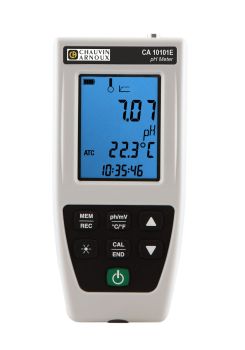
Chauvin Arnoux P01710011 pH meter lab analog output
| Lieske Part No. | 1142701 |
|---|---|
| Mfg Part No | P01710011 |
| EAN-Code | 3663653008976 |
| Manufacturer | Chauvin Arnoux |
| Here only | 537,30 EUR
639,39 EUR incl. VAT
|
Further information for Chauvin Arnoux P01710011 pH meter lab analog output
| General | |
| pH resolution | 0,01 pH |
| Intrinsic uncertainty pH | ±0,02 pH |
| Temperature resolution | 0,1 °C |
Applications
The pH meter CA 10101E is designed for laboratory applications requiring precise and reliable measurements of pH value, redox potential, and temperature. It is particularly used in educational institutions, scientific laboratories, and industrial control processes. Compatibility with computer-assisted experiments and with the software solutions Regressi and Graph 2D* makes it a suitable tool for experimental and documentation-based workflows. The device generation is designed for use in both fixed and mobile measurement setups.
Functions and Equipment in Detail
The device features a large internal memory capable of storing up to 100,000 measurement values with timestamps. The recording duration exceeds 200 hours. Data can be read out, visualized, configured, and exported using the included Data Logger Transfer software. The software also allows programming of recording intervals and adjustment of device settings. Calibration is performed automatically at up to three points for pH value and at one point for redox potential. Three predefined groups of calibration solutions are stored in the device and can be freely adjusted or extended by the user. Temperature compensation can be performed either automatically (ATC mode) or manually (MTC mode).
Technology Explained Simply
The pH value is measured in the range of -2.00 to 16.00, with a resolution of 0.01 pH. The inherent uncertainty is ±0.02 pH. The redox potential is measured in the range of ±199.9 mV to ±1999 mV, with a resolution of 0.1 mV in the ±199.9 mV range and 1 mV in the ±1999 mV range. The inherent uncertainty is ±0.2 mV in the ±199.9 mV range and ±2 mV in the ±1999 mV range. Temperature measurement is performed in the range of -10.0 to +120.0 °C (or 14.0 to 248.0 °F), with a resolution of 0.1 °C or 0.1 °F and an inherent uncertainty of ±0.4 °C or ±0.7 °F. The signal stability indicator supports safe reading of measurement values. The battery charge level indicator and power supply status via USB port inform the user about the operating status.
Compatibility and Accessories
The device is equipped with analog outputs enabling connection to interfaces for computer-assisted experiments. The µUSB port allows connection to the software solutions Regressi and Graph 2D*. Suitable accessories include various measurement electrodes such as the BAG1 argentometry measurement electrode, the BPT1 redox measurement electrode, the BR41 and BR42 pH and redox reference electrodes, as well as single-stem measurement chains such as BRV1H, BRV4H, BRAG1, and BRPT1. Additional accessories include temperature sensors such as the BT5 Pt100, buffer solutions for pH values 1.68, 4.01, 7.00, 9.18, 10.01, and a Michaelis buffer solution for redox measurements. COFRAC-certified buffer solutions for pH 4.005, 6.865, and 9.180 are also available. A USB power adapter is also available in the product range.
Mounting and Installation
The device is used directly at the workplace in the laboratory. It requires no special mounting. Connection to external devices is made via the analog outputs or the µUSB port. The Data Logger Transfer software is downloaded from the manufacturer’s website and is compatible with Windows. Installation follows standard software installation procedures.
Operational Advantages
The combination of large display, long recording duration, integrated memory, and software support enables efficient and documented measurement work. Simple calibration using predefined solutions and the ability to individually adjust calibration parameters increase flexibility. Temperature compensation in both modes (automatic and manual) adapts to different requirements. The robustness of the shock-protective housing protects the device during frequent use. Compatibility with standard software solutions for computer-assisted experiments facilitates integration into existing workflows.

This is an offer of:
79279 Vörstetten
https://industry-electronics.com
Tel. 07666/88499-0
Fax. 07666/88499-111
Diesen Artikel finden Sie unter:
industry-electronics.com/artikel/1142701

Lieske Elektronik e.K.
Reutener Str. 1079279 Vörstetten
https://industry-electronics.com
Tel. 07666/88499-0
Fax. 07666/88499-111
Diesen Artikel finden Sie unter:
industry-electronics.com/artikel/1142701