
Chauvin Arnoux P01191771A voltage tester with IP2X test probes
Measurement
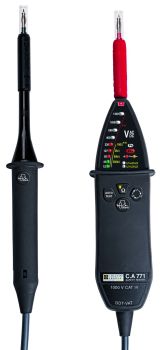
Chauvin Arnoux P01191771A voltage tester with IP2X test probes
| Lieske Part No. | 1927780 |
|---|---|
| Mfg Part No | P01191771A |
| EAN-Code | 3760171419250 |
| Manufacturer | Chauvin Arnoux |
| Here only | 237,60 EUR
282,74 EUR incl. VAT
|
Further information for Chauvin Arnoux P01191771A voltage tester with IP2X test probes
The two-pole voltage tester C.A 771 from Chauvin Arnoux is a specialised measuring instrument for verifying de-energisation in electrical installations, devices or circuits. It serves as a tool for electricians to ensure safety in accordance with standards before working on systems connected to the power grid. The device is designed for use indoors and outdoors, and operates reliably even under extreme climatic conditions. The safety category CAT IV 1000 V ensures maximum safety when measuring at main distribution boards and connection points in the low-voltage range. The protection rating IP65 protects the device against dust and splashing water, making it suitable for use in damp or dusty environments. The extended climate class S enables operation at temperatures from -30 °C to +60 °C.
Applications
The voltage tester is primarily used for voltage-free testing (VAT), as required by standards such as EN 50110-1, DIN VDE 0682-401 or NF C 18-510. It is suitable for all work on electrical installations below 1000 V. In addition, it can be used for phase detection, rotation direction testing, continuity testing, and testing the tripping function of residual current devices. The functions are relevant for testing sockets, wiring, switches and other electrical components in building and industrial applications.
Functions and Equipment in Detail
Voltage detection occurs in the range of 12 V AC to 1000 V AC and 12 V DC to 1400 V DC. The frequency ranges include direct current (DC) and alternating current from 16 2/3 Hz to 800 Hz. Indication is provided via LEDs, with an intermittent beep indicating voltage detection and a continuous beep indicating continuity testing. Phantom voltage detection is activated by switching to a low-impedance load, increasing the reliability of the measurement. The polarity indication allows differentiation between live and neutral conductors. The ELV-LED (Extra Low Voltage) serves as a redundant warning indicator and flashes at voltages above 50 V AC or 120 V DC, with the flashing frequency proportional to the voltage.
Technology Explained Simply
The tester features an integrated self-test that checks the electrical circuits, power supply, displays, and condition of the test leads. This ensures the device is functional before each measurement. The rotation direction test is performed using the two-wire method, eliminating the need for a third hand. The continuity test acoustically and optically signals a resistance below 100 Ω (typical, max. 150 Ω). Additionally, the tester offers an extended continuity test with optical indication for resistances below 2 kΩ, 60 kΩ, and 300 kΩ. The residual current device tripping test is performed by switching to a low-impedance load, generating a fault current of approximately 30 mA at 230 V. The test probes are removable and can be mounted at two clip positions with spacings of 16 mm or 19 mm, allowing adaptation to different connection types.
Compatibility and Accessories
Compatible accessories include protective sleeves for test probes with 2 mm Ø, sets of test probes in various versions (CAT IV, Ø 2 mm, Ø 4 mm, IP2X), a carrying case, and a probe protective cap. The optional socket adapter C.A 753 enables testing of 2P+T sockets according to European standards (Type E and F). The test probes are interchangeable to comply with national regulations, particularly the IP2X variants required for standards such as EN 61243-3.
Mounting and Installation
Mounting is done by simply inserting the removable test probes into the designated holders. The clip positions for 16 mm and 19 mm allow flexible adaptation to different connection geometries. Operation is via buttons, with the residual current device tripping requiring two-hand operation to prevent accidental activation.
Operational Advantages
The voltage tester offers high operational safety through redundant indicators, integrated self-test, and phantom voltage detection capability. The autonomy exceeds 5000 measurements at 10 seconds each, enabling long operating time without battery replacement. The combination of IP65 protection rating, Class S, and CAT IV 1000 V makes the device robust and reliable for demanding operating conditions. The functions comply with standards IEC 61243-3 and EN 61243-3, ensuring normative conformity. Testing is performed with a test current of ≤ 1 mA and an open voltage of ≤ 3.3 V, increasing safety during continuity testing.
Scope of Delivery
The voltage tester C.A 771 is delivered fully assembled and ready for operation. This includes the tester itself, removable test probes and test leads, and the operating instructions. The socket adapter C.A 753 is available as an optional accessory.
Standards and Safety
The device complies with standards IEC 61243-3:2009, EN 61243-3:2010, and IEC 61010 for 1000 V CAT IV. Safety features include the redundant ELV-LED indicator, integrated self-test, and phantom voltage detection. The IP65 protection rating and climate class S ensure suitability for harsh environments.

This is an offer of:
79279 Vörstetten
https://industry-electronics.com
Tel. 07666/88499-0
Fax. 07666/88499-111
Diesen Artikel finden Sie unter:
industry-electronics.com/artikel/1927780

Lieske Elektronik e.K.
Reutener Str. 1079279 Vörstetten
https://industry-electronics.com
Tel. 07666/88499-0
Fax. 07666/88499-111
Diesen Artikel finden Sie unter:
industry-electronics.com/artikel/1927780