
Chauvin Arnoux P01191762Z voltage tester
Measurement
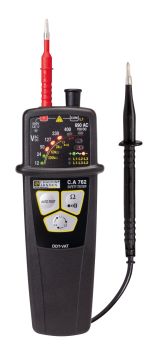
Chauvin Arnoux P01191762Z voltage tester
| Lieske Part No. | 1927774 |
|---|---|
| Mfg Part No | P01191762Z |
| EAN-Code | 3760171419915 |
| Manufacturer | Chauvin Arnoux |
| Here only | 96,04 EUR
114,29 EUR incl. VAT
|
Further information for Chauvin Arnoux P01191762Z voltage tester
| Eigenschaften | |
| Continuity with buzzer, test current | ≤ 1 mA |
| Dimensions / weight | 163 x 64 x 40 mm / 210 g |
Applications
The CA 762 is primarily used for voltage testing prior to work on electrical installations to ensure actual de-energisation. It is suitable for industrial, commercial, and domestic electrical installations. The functions include detection of alternating and direct voltage, identification of live conductors (phase), and phase sequence testing. Additionally, it enables continuity testing, which provides acoustic and optical indication for resistances below 100 Ω. The extended continuity test offers additional visual indications for resistances below 2 kΩ, 60 kΩ, and 300 kΩ. The single-pole live conductor detection allows identification of the phase using only one test probe, increasing work efficiency.
Functions and Equipment in Detail
The device performs a complete self-test, checking the electrical circuits, power supply, displays, and condition of the test leads. Voltage detection occurs in the range of 12 V to 690 V AC (frequency 16 2/3 Hz to 800 Hz) and 12 V to 750 V DC. The impedance is greater than 400 kΩ, and the maximum current is 3.5 mA RMS. Polarity is automatically displayed, and the voltage type (AC/DC) is also optically recognisable. A red ELV-LED (Extra Low Voltage) flashes when the applied voltage exceeds SELV (Safe Extra Low Voltage), with the flashing frequency increasing with rising voltage. This serves as a redundant safety function, especially under weak battery supply.
Technology Explained Simply
Phase sequence testing is performed using the 2-wire method, determining the rotation direction (e.g. L1-L2-L3 or L1-L3-L2) without requiring a third hand. Continuity testing is activated by pressing the Ω button and provides acoustic and optical indication for resistances below 100 Ω (typical, max. 150 Ω). The test current is up to 1 mA, and the open-circuit voltage is at most 3.3 V. The device’s protection function extends up to 1000 V. Phase-to-phase voltage is measured in the range of 50 V to 690 V AC, with frequencies between 45 and 400 Hz. The buzzer emits an intermittent beep during voltage detection and a continuous tone during continuity testing.
Compatibility and Accessories
The test probes and test leads are detachable, facilitating replacement and maintenance. The device is compatible with optional adapters such as the CA 753, which enables safe voltage testing at protective earth contact sockets. Accessories include various test probes (e.g. 2 mm Ø, IP2X), test leads (e.g. 1.5 m, 4 mm angled plug, CAT IV 600 V), protective sleeves, and carrying cases. The IP2X test probes offer additional operator protection and are required in some countries.
Mounting and Installation
Installation is performed by direct contact of the test probes with the conductors to be tested. The detachable components allow flexible adaptation to different connection types. The test probes are equipped with springs providing a contact force of 10 N to ensure reliable measurement even when using personal protective equipment (PPE).
Operational Advantages
The CA 762 offers high safety through the integrated self-test and redundant ELV-LED. The IP65 protection rating enables use in various environments, and the CAT IV 600 V classification ensures suitability for heavily stressed installations. Detachable test probes and test leads increase flexibility and simplify replacement. The extended continuity test and rotation direction indication expand functionality for complex testing. Power supply is via two 1.5-V batteries (LR03), with an autonomy of 7000 measurements of 10 seconds each. Dimensions are 163 x 64 x 40 mm, weight 210 g, ensuring convenient handling. Batteries are not included in the delivery scope.

This is an offer of:
79279 Vörstetten
https://industry-electronics.com
Tel. 07666/88499-0
Fax. 07666/88499-111
Diesen Artikel finden Sie unter:
industry-electronics.com/artikel/1927774

Lieske Elektronik e.K.
Reutener Str. 1079279 Vörstetten
https://industry-electronics.com
Tel. 07666/88499-0
Fax. 07666/88499-111
Diesen Artikel finden Sie unter:
industry-electronics.com/artikel/1927774