
Chauvin Arnoux P01139716 insulation tester 15 kV
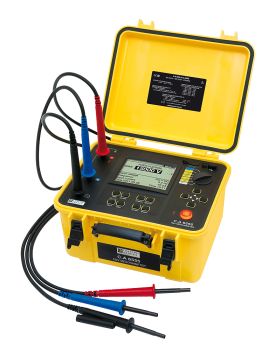
Chauvin Arnoux P01139716 insulation tester 15 kV
| Lieske Part No. | 1142551 |
|---|---|
| Mfg Part No | P01139716 |
| EAN-Code | 3663653008754 |
| Manufacturer | Chauvin Arnoux |
| Here only | 7.570,94 EUR
9.009,42 EUR incl. VAT
|
Further information for Chauvin Arnoux P01139716 insulation tester 15 kV
| Eigenschaften | |
| Test voltages | 15 kV |
| Insulation measurement, fixed test voltages | 500 / 1000 / 2500 / 5000 / 10.000 / 15.000 V |
| Voltage measurement before and after test | AC : 0 - 2500 V DC : 0 - 4000 V |
| Capacitance measurement (> 500 V) | 0,001-9,999 µF / 10,00-19,99 µF |
| Graphics on display | R(t)+u(t) ; i(t) ; i(u) |
| Dimensions / weight | 406 x 330 x 174 mm, ca. 6 kg |
| Calculation of R at reference temperature | |
Applications include testing systems operated at 12 kV or higher, as well as compliance with the recommendations of IEEE 43, which prescribes test voltages between 5 and 10 kV for rotating machines. The device is used by electricity suppliers, plant manufacturers, installers, maintenance companies, research centres, and infrastructure operators. Its robust construction with an IP53 housing makes it suitable for use on construction sites.
Functions and equipment in detail include multiple testing methods: ramp mode with three pre-configured ramps (start and end voltage, as well as duration adjustable), step mode with up to ten configurable steps, and the burn-in mode for long-term tests. Additional test stop modes include a programmable I-limit (0.2–5 mA), an early breakdown (di/dt), and a timer up to 99:59 minutes. Automatic discharge after testing enhances safety. Leakage current measurement is performed in the range of 0 to 8 mA, while capacitance measurement at voltages above 500 V covers ranges of 0.001–9.999 µF and 10.00–19.99 µF. Voltage can be measured before and after the test (AC 0–2500 V, DC 0–4000 V).
Technology explained clearly is shown through graphical representation on the large, backlit LCD display, which displays curves such as R(t)+u(t), i(t), and i(u). The calculation of ratios such as DAR, PI, DD, SV, DR (ppm/V) enables deeper analysis of insulation quality. Resistance conversion to a reference temperature aids in comparing measurements under different conditions. Three digital filters with variable time constants stabilize measurement results and reduce noise interference. The storage capacity is 256 recordings with a total of 80,000 measurement points (R, U, I, timestamp), enabling detailed documentation.
Compatibility and accessories include the use of high-voltage test leads (e.g. 3 m, 8 m, 15 m) with crocodile clips, test probes with 4 mm socket CAT IV and CAT III 1000 V, as well as simplified HV test leads. An optical USB cable and a network cable are also available. Communication is via an opto-isolated USB interface (and RS232), enabling secure data transfer to a PC. The PC software DataView® is used for evaluation and reporting of measurement results.
Mounting and installation are carried out directly at the test object using the provided test leads. Power supply is via rechargeable NiMH batteries (8 x 1.2 V / 4000 mAh), which are charged using an external charger (90–260 V, 50/60 Hz). The device has dimensions of 406 x 330 x 174 mm and weighs approximately 6 kg.
Operational advantages lie in high measurement accuracy, the variety of testing methods, secure data archiving, and easy integration into maintenance processes. The graphical display and calculation of insulation parameters enable quick and reproducible assessment of insulation conditions. Compliance with standards IEC 61557 and IEC 61010-1, as well as CAT IV approval, ensure safe operation in critical environments. The ability to track measurements over time supports planning of preventive maintenance and reduces downtime.

This is an offer of:
79279 Vörstetten
https://industry-electronics.com
Tel. 07666/88499-0
Fax. 07666/88499-111
Diesen Artikel finden Sie unter:
industry-electronics.com/artikel/1142551

Lieske Elektronik e.K.
Reutener Str. 1079279 Vörstetten
https://industry-electronics.com
Tel. 07666/88499-0
Fax. 07666/88499-111
Diesen Artikel finden Sie unter:
industry-electronics.com/artikel/1142551