
Chauvin Arnoux P01129600 FTV 500 multifunction tester for PV systems
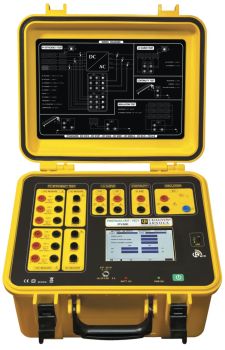
Chauvin Arnoux P01129600 FTV 500 multifunction tester for PV systems
| Lieske Part No. | 1142542 |
|---|---|
| Mfg Part No | P01129600 |
| EAN-Code | 3663653008846 |
| Manufacturer | Chauvin Arnoux |
| Here only | 13.033,20 EUR
15.509,51 EUR incl. VAT
|
Further information for Chauvin Arnoux P01129600 FTV 500 multifunction tester for PV systems
| Eigenschaften | |
| Mechanical properties, dimensions | 340 x 300 x 200mm |
Applications
The FTV500 is used in the photovoltaic industry to check the electrical safety, performance efficiency and functionality of PV systems. It is suitable for technical specialists involved in the installation, maintenance or inspection of solar systems. Measurement of DC/AC conversion efficiency, active and theoretical power, and power factor at inverter outputs is performed via 3 DC and 3 AC measurement channels. The results are correlated with environmental data such as irradiance and temperature, collected by a remote measurement unit.
Functions and Equipment in Detail
The device features a 5-inch colour TFT touchscreen with a resolution of 800x480 pixels and optical bonding, ensuring clear and robust display even in daylight. It offers I-V curve measurement for modules and strings up to 1000 V and 15 A, with results compared to the STC reference values provided by the module manufacturer. A quick test enables measurement of open-circuit voltage and short-circuit current for individual modules or parallel-connected strings. Insulation testing is performed using a megohmmeter or under system operation, without requiring an external switch for short-circuiting. The test voltage can be selected between 250 V, 500 V and 1000 VDC, and a threshold alarm value can be programmed to evaluate the result as passed" or "failed. Earth conductor continuity testing is performed with a test current of 200 mA, as required by standards.
Technology Explained Simply
The remote measurement unit collects environmental parameters such as irradiance, ambient and module temperature in real time and transmits them via Wi-Fi to the main device. Transmission occurs over a distance of more than 200 metres in open field. In case of signal interruption, the remote unit autonomously stores data and synchronises it later once the connection is re-established. The device supports remote control via VNC technology (Virtual Network Computing), allowing measurements to be controlled and monitored from a PC, tablet or smartphone. The data logger function enables recording of over 600,000 measurements, with internal memory designed for more than 10,000 measurement blocks. Results can be processed directly on the device into test reports.
Compatibility and Accessories
The FTV500 is compatible with a remote measurement unit that communicates with the device via Wi-Fi. Additional accessories include coloured identification parts, an inclinometer, a flexible current transformer Miniflex MA500, a DC current clamp PAC 500, and flexible connection adapters for screw terminals (3 x red / 3 x black) to support measurements. The device connections are 4-mm banana plugs.
Mounting and Installation
The device is designed as a portable field instrument and does not require fixed mounting. The remote measurement unit is positioned at the installation to capture environmental data. Measurements are performed using the 3 DC and 3 AC clamps connected to the respective conductors. Operation is via the touchscreen, with VNC control enabling remote operation.
Operational Advantages
The FTV500 offers comprehensive analysis of photovoltaic systems with a single device. The combination of I-V curve analysis, insulation testing, efficiency determination and data logger function reduces the number of required devices. Remote control via VNC and Wi-Fi enables efficient collaboration between technicians on site and experts in the office. Storage of over 600,000 measurements and the ability to generate reports directly on the device increase work efficiency. Power supply is via rechargeable Li-Ion batteries with an autonomy of 15 hours or via mains power (100–240 V, 50–60 Hz). The remote measurement unit is also powered by rechargeable Li-Ion batteries and can be charged via USB. The device is equipped with an IP54 protection rating (IEC 60529), making it suitable for outdoor use. Electrical safety complies with IEC 61010, with a category of 1000 V CAT II to 600 V CAT IV depending on the measurement. The warranty period is 2 years.

This is an offer of:
79279 Vörstetten
https://industry-electronics.com
Tel. 07666/88499-0
Fax. 07666/88499-111
Diesen Artikel finden Sie unter:
industry-electronics.com/artikel/1142542

Lieske Elektronik e.K.
Reutener Str. 1079279 Vörstetten
https://industry-electronics.com
Tel. 07666/88499-0
Fax. 07666/88499-111
Diesen Artikel finden Sie unter:
industry-electronics.com/artikel/1142542