
Chauvin Arnoux P01102084A probe for continuity testing
Measurement > Measuring Accessories > Other
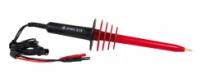
Chauvin Arnoux P01102084A probe for continuity testing
| Lieske Part No. | 854521 |
|---|---|
| Mfg Part No | P01102084A |
| EAN-Code | 3760171418000 |
| Manufacturer | Chauvin Arnoux |
| Here only | 93,10 EUR
110,79 EUR incl. VAT
|
Further information for Chauvin Arnoux P01102084A probe for continuity testing
| General | |
| Length per extension piece | 30 cm |
| Total length | 90 cm |
| Socket diameter | 4 mm |
| Maximum voltage | 1000 V |
Continuity testing is a standard procedure in electrical engineering to check the integrity of electrical connections. The extension pieces are optimized for this purpose, as they ensure a stable and insulated connection. Each piece is equipped with an insulated socket with a diameter of 4 mm. This socket allows for a secure and reliable connection with corresponding test cables or probes, which are also fitted with 4-mm connectors. The insulation protects the user from dangerous touch or breakdown voltages.
Protection up to max. 1000 V is the maximum voltage for which the set is designed. This value corresponds to a high safety standard and makes the product suitable for use in installations operating at voltages up to 1 kV, for example, in industrial or commercial electrical installations. The insulation of the sockets and rods ensures that the user is not endangered when handled correctly, as long as the voltage does not exceed 1000 V.
The total length of 90 cm is achieved by combining the three 30-cm extension pieces. The rods are modular, allowing them to be used individually or in combination as needed. This provides flexibility when working on components of different sizes or depths. The extension pieces are robustly constructed to withstand repeated use in professional environments.
The delivery includes a storage bag that safely and orderly holds all three extension pieces. The bag protects the rods from damage and prevents loss, especially in mobile applications such as on-site inspections. Additionally, a safety application guide is included, providing instructions for correct handling and safe use of the product.
The set is designed for use in laboratories, electrical installations, and maintenance of electrical systems. It is particularly suitable for technicians who need to use an extended measuring rod when testing switchgear, cables, or electrical devices to work safely and efficiently. The combination of insulation, robust design, and modular construction makes it a reliable tool for professional applications.
The extension pieces are not intended for use with voltages exceeding 1000 V. The maximum voltage is a critical safety parameter that must be considered when selecting the appropriate test tool. The insulation of the sockets and rods is designed for this voltage range to prevent breakdown. The application is carried out in accordance with applicable safety regulations and standards in electrical engineering.
The storage bag ensures structured storage and facilitates transport. It is robust enough to protect the rods from mechanical damage and provides quick access when needed. The safety application guide supports the user in correct handling and helps avoid errors.
The extension pieces are not supplied with additional tools, adapters, or cables. They serve exclusively as an extension for existing test instruments or measuring rods that feature 4-mm plug connections. Compatibility is ensured as long as the devices used support the 4-mm plug connection.
The insulated socket with 4 mm Ø is a standard connection in electrical engineering and allows universal use with many measuring instruments. The insulation protects the user and prevents unintended electrical contacts. The maximum voltage of 1000 V is a clearly defined safety limit that must be considered when selecting the product.
The total length of 90 cm provides sufficient reach for many applications, especially in enclosed switch cabinets or when testing cables in vertical or deep installations. The modular structure allows the length to be adjusted as needed, making the set flexible in use.
The safety application guide is part of the delivery and provides instructions for correct handling. It is not intended as technical documentation in the sense of an operating manual for a complex device, but serves as a brief orientation aid for safe handling of the product.
The extension pieces are not intended for use in explosive environments. The safety specifications refer exclusively to electrical insulation and maximum voltage.
The storage bag is made of robust material and provides sufficient space for all three extension pieces. It is not designed for transporting additional tools or equipment, but serves exclusively for storing the rods.
The extension pieces are not marked with any indication of a specific standard or certification. The specification of the maximum voltage of 1000 V is the only technical specification mentioned in relation to safety. The insulation meets the requirements for use up to 1000 V, although no specific standard (e.g. IEC 61243) is named.
Continuity testing is typically performed with a test instrument that has a measuring function for electrical conductivity. The extension pieces serve as a mechanical extension of the test contact to reach points that are not directly accessible. The electrical function remains unchanged, as the rods only provide the mechanical connection.
The insulated socket is a central component, as it establishes the electrical connection safely and reliably without the user coming into contact with conductive parts. The 4-mm plug connection is a standard in electrical engineering and is supported by many measuring instruments.
The total length of 90 cm is achieved by combining the three 30-cm extension pieces. The rods are not adjustable, but must be assembled modularly. Assembly is done by simply inserting the sockets into each other, ensuring a secure connection.
The storage bag is not specified for use at high temperatures or in humid environments. It serves only the mechanical protection and storage function. The safety application guide is written in German and refers to the correct handling of the product.
The extension pieces are not marked with any indication of a specific certification or conformity with a standard. The specification of the maximum voltage of 1000 V is the only technical specification mentioned in relation to safety. The insulation meets the requirements for use up to 1000 V, although no specific standard (e.g. IEC 61243) is named.
Continuity testing is a procedure used in electrical engineering to check the electrical conductivity between two points. The extension pieces enable this test to be carried out at hard-to-reach locations without the user having to work in close proximity to conductive parts. The insulation of the sockets and rods protects the user from dangerous voltages up to 1000 V.
The insulated socket with 4 mm Ø is a standard connection used in many measuring instruments and test probes. The insulation prevents unintended electrical contacts and protects the user. The maximum voltage of 1000 V is a clearly defined safety limit that must be considered when selecting the product.
The total length of 90 cm provides sufficient reach for many applications, especially in enclosed switch cabinets or when testing cables in vertical or deep installations. The modular structure allows the length to be adjusted as needed, making the set flexible in use.
The safety application guide is part of the delivery and provides instructions for correct handling. It is not intended as technical documentation in the sense of an operating manual for a complex device, but serves as a brief orientation aid for safe handling of the product.
The extension pieces are not intended for use in explosive environments. The safety specifications refer exclusively to electrical insulation and maximum voltage.
The storage bag is made of robust material and provides sufficient space for all three extension pieces. It is not designed for transporting additional tools or equipment, but serves exclusively for storing the rods.
The extension pieces are not marked with any indication of a specific standard or certification. The specification of the maximum voltage of 1000 V is the only technical specification mentioned in relation to safety. The insulation meets the requirements for use up to 1000 V, although no specific standard (e.g. IEC 61243) is named.
Continuity testing is typically performed with a test instrument that has a measuring function for electrical conductivity. The extension pieces serve as a mechanical extension of the test contact to reach points that are not directly accessible. The electrical function remains unchanged, as the rods only provide the mechanical connection.
The insulated socket is a central component, as it establishes the electrical connection safely and reliably without the user coming into contact with conductive parts. The 4-mm plug connection is a standard in electrical engineering and is supported by many measuring instruments.
The total length of 90 cm is achieved by combining the three 30-cm extension pieces. The rods are not adjustable, but must be assembled modularly. Assembly is done by simply inserting the sockets into each other, ensuring a secure connection.
The storage bag is not specified for use at high temperatures or in humid environments. It serves only the mechanical protection and storage function. The safety application guide is written in German and refers to the correct handling of the product.
The extension pieces are not marked with any indication of a specific certification or conformity with a standard. The specification of the maximum voltage of 1000 V is the only technical specification mentioned in relation to safety. The insulation meets the requirements for use up to 1000 V, although no specific standard (e.g. IEC 61243) is named.

This is an offer of:
79279 Vörstetten
https://industry-electronics.com
Tel. 07666/88499-0
Fax. 07666/88499-111
Diesen Artikel finden Sie unter:
industry-electronics.com/artikel/854521

Lieske Elektronik e.K.
Reutener Str. 1079279 Vörstetten
https://industry-electronics.com
Tel. 07666/88499-0
Fax. 07666/88499-111
Diesen Artikel finden Sie unter:
industry-electronics.com/artikel/854521