
Chauvin Arnoux P01102021 accessory set earth resistance measurement 2 electrodes 50 m
Measurement > Other Measuring Devices
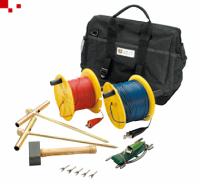
Chauvin Arnoux P01102021 accessory set earth resistance measurement 2 electrodes 50 m
| Lieske Part No. | 218634 |
|---|---|
| Mfg Part No | P01102021 |
| EAN-Code | 3760171412152 |
| Manufacturer | Chauvin Arnoux |
| Here only | 293,02 EUR
348,69 EUR incl. VAT
|
Further information for Chauvin Arnoux P01102021 accessory set earth resistance measurement 2 electrodes 50 m
| General | |
| Adapter | 5 Stück |
| Cable lengths | 50 m, 100 m, 150 m, 166 m m |
Applications
This accessory kit is used in electrical installation, facility management, and testing of protective measures. It is used to determine the grounding resistance of installations, buildings, or technical equipment to ensure electrical safety. The measurement is carried out using T-electrodes (grounding rods) and color-coded cables, available in various lengths (50 m, 100 m, 150 m, 166 m) depending on requirements. The cables are color-coded to enable clear assignment to the connection terminals of the measuring instruments and to avoid wiring errors.
Functions and Equipment in Detail
The kit includes, depending on the variant, 1, 2 or 4 grounding electrodes (T-electrodes), which are driven into the ground to establish an electrical contact with the earth. The cables are wound on reels and available in various lengths, with the length varying according to the measurement method and the required measurement distance. The cables are color-coded (e.g. red, blue, green), which facilitates assignment to the corresponding connection terminals of the measuring instruments. Additionally, 5 adapters with fork terminals and 4-mm banana plugs are included, enabling universal connection to various measuring instruments regardless of their connection type.
Technology Explained Simply
The 1-, 3- and 4-wire measurement methods are based on measuring the resistance between a grounding point and a reference point in the ground. In the 3-wire method, a grounding point is connected to two additional electrodes (auxiliary and potential electrodes) to precisely determine the resistance. The 4-wire method allows for even more accurate measurement, as the current and voltage measurement circuits are separated. Cable extensions in lengths of 50 m, 100 m or 150 m enable adaptation to different measurement distances. The color coding of the cables (e.g. green for grounding, red and blue for auxiliary and potential leads) reduces the risk of errors during wiring.
Compatibility and Accessories
The accessory kit is compatible with all grounding measurement instruments from Chauvin Arnoux, regardless of the connection type, thanks to the included 4-mm banana plug adapters. For specific applications such as soil resistance measurement, the kit can be supplemented with an additional accessory set (100 m) containing 2 reels and 2 grounding electrodes. Another accessory set for continuity testing includes 4 test leads with 4-mm banana plugs, 4 crocodile clips and 2 test probes, making it suitable for testing electrical conductors and contacts.
Installation and Mounting
Installation is carried out by driving the grounding electrodes into the ground using the included hammer. The cables are connected to the corresponding terminals of the measuring instruments and to the grounding electrodes. The color coding of the cables facilitates correct assignment. The transport bag provides protected and organized transport of the components as well as secure storage after use.
Operational Advantages
The use of high-quality materials ensures long-term durability. The color coding of the cables and the universal adapters reduce the risk of errors and speed up installation. The transport bag enables easy transport and structured storage. The cables are available in lengths of 50 m, 100 m or 150 m, allowing flexible adaptation to different measurement conditions. The accessory kits are modular in design, so they can be expanded according to requirements.

This is an offer of:
79279 Vörstetten
https://industry-electronics.com
Tel. 07666/88499-0
Fax. 07666/88499-111
Diesen Artikel finden Sie unter:
industry-electronics.com/artikel/218634

Lieske Elektronik e.K.
Reutener Str. 1079279 Vörstetten
https://industry-electronics.com
Tel. 07666/88499-0
Fax. 07666/88499-111
Diesen Artikel finden Sie unter:
industry-electronics.com/artikel/218634