
Chauvin Arnoux BR42-S7 pH and Redox Reference Electrode S7 Connector
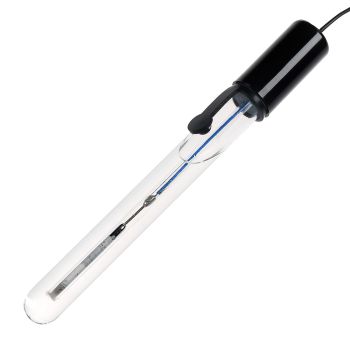
Chauvin Arnoux BR42-S7 pH and Redox Reference Electrode S7 Connector
| Lieske Part No. | 1142362 |
|---|---|
| Mfg Part No | BR42-S7 |
| EAN-Code | 3663653005937 |
| Manufacturer | Chauvin Arnoux |
| Here only | 249,60 EUR
297,02 EUR incl. VAT
|
Further information for Chauvin Arnoux BR42-S7 pH and Redox Reference Electrode S7 Connector
| General | |
| Refillable | |
Applications
The BR42-S7 is suitable for a wide range of applications in laboratory and field measurements, particularly in areas where high stability of the reference potential is required. It is used in combination with measuring electrodes such as BV41A/H or XV41 to determine precise pH values. The electrode is especially suitable for applications where chloride ions do not react with components of the measuring solution, such as silver ions, as this could cause the formation of silver chloride precipitate. In such cases, a reference electrode based on mercury sulfate is recommended.
Functions and Equipment in Detail
The reference electrode is based on the calomel system (Hg/Hg₂Cl₂), known as a saturated calomel electrode (SCE). Inside the glass body, there is a drop of mercury and a drop of mercury chloride (calomel) on a platinum wire. The saturated KCl solution acts as the electrolyte and ensures electrical connection between the electrode and the measuring solution. The ceramic diaphragm ensures controlled diffusion of the electrolyte, enabling continuous and stable measurement. The electrode has a low temperature coefficient, meaning the measurement values are only slightly dependent on temperature fluctuations.
Technology Explained Simply
In pH measurements, the potential difference between the measuring electrode (which reacts to hydronium ions) and the reference electrode (which provides a constant potential) is recorded. The measuring device converts this difference into a pH value. The BR42-S7 ensures that the reference potential remains stable during measurement, which is crucial for measurement accuracy. The use of a separate reference element allows the service life of the measuring electrode to be evaluated independently of the reference electrode and, if necessary, replaced individually.
Compatibility and Accessories
The BR42-S7 is compatible with measuring electrodes of type BV41A/H and XV41. Available accessories include solutions, such as a potassium chloride solution (3 mol/L, 30 mL) and a pepsin/HCl solution (125 mL), suitable for maintenance and calibration of the electrode. The electrode is refillable, allowing maintenance and replacement of the electrolyte to maintain functionality over a longer period.
Mounting and Installation
The electrode is connected to the measuring device via the S7 plug. Mounting is done by screwing the plug onto the device. The electrode is designed for use in laboratory and field environments and does not require special mounting aids. The cable length is 1 meter, providing sufficient reach for most application scenarios.
Advantages in Operation
The BR42-S7 offers long-term stability of the reference potential, leading to reproducible and reliable measurement results. The low temperature coefficient minimizes measurement errors due to temperature fluctuations. The refillable electrolyte extends the electrode's service life and reduces replacement needs. The use of a ceramic diaphragm ensures controlled diffusion and prevents uncontrolled leakage of the electrolyte.

This is an offer of:
79279 Vörstetten
https://industry-electronics.com
Tel. 07666/88499-0
Fax. 07666/88499-111
Diesen Artikel finden Sie unter:
industry-electronics.com/artikel/1142362

Lieske Elektronik e.K.
Reutener Str. 1079279 Vörstetten
https://industry-electronics.com
Tel. 07666/88499-0
Fax. 07666/88499-111
Diesen Artikel finden Sie unter:
industry-electronics.com/artikel/1142362