
Busch Jaeger 2CKA006599A2266 potentiometer 2112-101
Installation > Switch Material > Switch Electronics
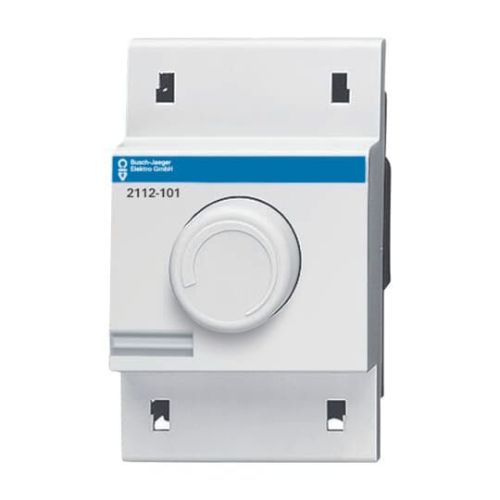
Busch Jaeger 2CKA006599A2266 potentiometer 2112-101
| Lieske Part No. | 576531 |
|---|---|
| Mfg Part No | 2CKA006599A2266 |
| EAN-Code | 4011395631201 |
| Manufacturer | Busch Jaeger |
| Here only | 110,20 EUR
131,14 EUR incl. VAT
|
Further information for Busch Jaeger 2CKA006599A2266 potentiometer 2112-101
| General | |
| Number of modules (module system) | 3 |
| Type of load | Universal |
| Mounting method | Other |
| Type of fastening | Snapper mounting |
| Material | Plastic |
| Material quality | Thermoplastic |
| Surface protection | Untreated |
| Surface finishing | Matt |
| Colour | Grey |
| RAL-number (akin) | 7035 |
| Suitable for degree of protection (IP) | IP20 |
| Impact strength | IK00 |
| Nominal voltage | 230 |
| Control voltage | 10 |
| Width of device | 71 |
| Height of device | 71 |
| Depth of device | 53 |
| Light value memory | |
| Halogen free | |
| IFTTT support available | |
Applications
The 2112-101 is used in electrical installations where dimmable lighting is implemented via electronic ballasts. This includes both fluorescent lamps and LED lighting, provided they are operated via a ballast with 1-10 V DC control. Applications are typically found in residential and commercial buildings where stepless brightness control is required. The device width of 71 mm, height of 71 mm, and depth of 53 mm correspond to the standard for 3-module installations in German electrical installations.
Functions and Equipment in Detail
The device features a light level memory, which stores the last set brightness value and restores it upon re-energizing. The surface is matte and gray, matching RAL number 7035, and is made of a thermoplastic material. Mounting is done via click-fastening, enabling quick and secure installation in standard installation rails. The mounting is designed for use in electrical distributions, with protection rating IP20 indicating suitability for indoor use without direct mechanical or thermal stress.
Technology Explained Simply
The dimmer operates as an analog potentiometer, variably setting the control voltage from 1 to 10 V DC. This voltage is transmitted to the electronic ballast, which then adjusts the power supplied to the connected lamp accordingly. The load type is universal, meaning the device is suitable for both inductive and capacitive loads. The rated voltage is 230 V, while the control voltage is 10 V DC. The maximum control power is not explicitly specified, but the maximum current draw is limited to 50 mA DC. The impact resistance is rated IK00, indicating low mechanical stress.
Compatibility and Accessories
The 2112-101 is specifically designed for electronic ballasts featuring a 1-10 V DC control input. It is therefore compatible with fluorescent lamps and LED lighting operated via such ballasts. The use of additional relays is required in installations with high inrush currents to limit the electrical load on the dimmer.
Mounting and Installation
Mounting is done via click-fastening in standard installation rails, commonly used in German electrical installations. The device dimensions of 71 mm width, 71 mm height, and 53 mm depth correspond to the format for 3-module installations. The surface is untreated and matte, allowing easy integration into existing installations. Mounting requires no additional tools or special preparations, provided the distribution rail is appropriately designed.
Advantages in Operation
Using the 2112-101 enables stepless brightness control of lighting systems operated via electronic ballasts. The light level memory ensures the last set value is restored upon re-energizing, enhancing user-friendliness. The click-fastening simplifies installation and reduces installation time. The universal load type allows use in various application scenarios, although the 50 mA control current limit restricts use in installations with high inrush currents, where additional relays are required.

This is an offer of:
79279 Vörstetten
https://industry-electronics.com
Tel. 07666/88499-0
Fax. 07666/88499-111
Diesen Artikel finden Sie unter:
industry-electronics.com/artikel/576531

Lieske Elektronik e.K.
Reutener Str. 1079279 Vörstetten
https://industry-electronics.com
Tel. 07666/88499-0
Fax. 07666/88499-111
Diesen Artikel finden Sie unter:
industry-electronics.com/artikel/576531