
Busch Jaeger 2CKA001724A1747 Cover for antenna socket 3-conn white
Installation > Switch Material > Switch Flush standard
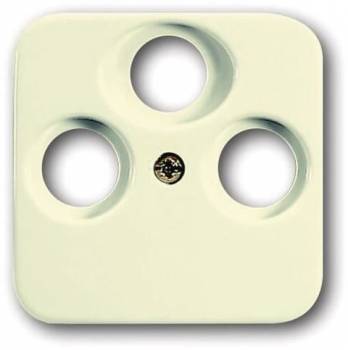
Busch Jaeger 2CKA001724A1747 Cover for antenna socket 3-conn white
| Lieske Part No. | 214411 |
|---|---|
| Mfg Part No | 2CKA001724A1747 |
| EAN-Code | 4011395537206 |
| Manufacturer | Busch Jaeger |
| Here only | 6,61 EUR
7,87 EUR incl. VAT
|
Further information for Busch Jaeger 2CKA001724A1747 Cover for antenna socket 3-conn white
| General | |
| Assembly arrangement | Central cover plate |
| Utilization | SAT |
| Outlet direction | Straight |
| Imprintable label | Without indication field |
| Mounting method | Flush mounted (plaster) |
| Material | Plastic |
| Material quality | Thermoplastic |
| Surface protection | Untreated |
| Surface finishing | Glossy |
| Colour | White |
| RAL-number (akin) | 1013 |
| Type of fastening | Mounting with screw |
| Suitable for number of connectors | 3 |
| Suitable for degree of protection (IP) | IP20 |
| Width of device | 54 |
| Height of device | 54 |
| Depth of device | 12.5 |
| Impact strength | IK03 |
| Support ring | |
| With dust cover | |
| With hinged lid | |
| With imprint | |
| Halogen free | |
| Transparent | |
| With buses/couplings | |
| With strain relief | |
| Shielded buses | |
| Shielded housing | |
| Luster terminal | |
| Antibacterial treatment | |
| With lighting | |
Applications
The central plate is suitable for use in residential and commercial rooms where structured cabling for antenna signals is required. It is used in conjunction with corresponding antenna sockets installed in the wall. The application is limited to indoor use, as the protection rating IP20 does not provide protection against water or dust. The connection options are designed for the transmission of high-frequency signals, as commonly used in radio and satellite reception.
Functions and Equipment in Detail
The device features three connection openings intended for the installation of coaxial sockets. The finish is white, corresponding to RAL 1013. The surface is glossy and made of thermoplastic, with the material being halogen-free. The cover has no labeling field, no print, and no integrated lighting. Fastening is done via screw, with no integrated strain relief or sockets/couplings. The central plate is not designed for mounting sockets or couplings, but serves exclusively as a cover for already installed sockets.
Technology Explained Simply
The central plate is a purely mechanical component that does not perform any electrical function. Its purpose is to provide optical and mechanical closure for installed antenna sockets. The protection rating IP20 means the device is protected against contact with fingers and against solid foreign objects larger than 2.5 mm, but not against water or dust. The impact resistance IK03 indicates that the device is protected against minor mechanical stress, but is not suitable for high mechanical loads. Dimensions are 54 mm width, 54 mm height, and 12.5 mm depth, enabling a compact installation solution.
Compatibility and Accessories
The central plate is designed for use with antenna sockets installed in the wall. The central plate is not intended for use with shielded sockets or enclosures, as no shielding is integrated.
Installation and Mounting
Installation takes place in the flush-mounted area, where the central plate is inserted into the pre-drilled opening in the wall. Fastening is done using a central M3 screw. Installation does not require special tools, but correct alignment of the connection openings is important to ensure a proper connection of the sockets. The cover is not suitable for outdoor use, as it does not offer weather protection.
Advantages in Operation
The central plate provides a clean and uniform visual appearance for the installation of antenna sockets. The use of three connections allows simultaneous use of radio, TV, and SAT signals at one location. The halogen-free material choice contributes to safety, especially in enclosed spaces. The glossy surface and white color fit into most interior designs. The simple installation with central fastening facilitates the work for electricians.

This is an offer of:
79279 Vörstetten
https://industry-electronics.com
Tel. 07666/88499-0
Fax. 07666/88499-111
Diesen Artikel finden Sie unter:
industry-electronics.com/artikel/214411

Lieske Elektronik e.K.
Reutener Str. 1079279 Vörstetten
https://industry-electronics.com
Tel. 07666/88499-0
Fax. 07666/88499-111
Diesen Artikel finden Sie unter:
industry-electronics.com/artikel/214411