
BlackBox LGC5152A media converter 3-ports SM SC
Networks > Media-Converters
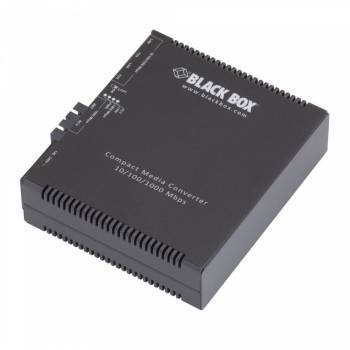
BlackBox LGC5152A media converter 3-ports SM SC
| Lieske Part No. | 961093 |
|---|---|
| Mfg Part No | LGC5152A |
| EAN-Code | |
| Manufacturer | BlackBox |
| Here only | 816,00 EUR
971,04 EUR incl. VAT
|
Further information for BlackBox LGC5152A media converter 3-ports SM SC
| General | |
| Connections | 2x RJ-45, 1x singlemode SC |
| Interfaces | RJ-45: 10/100/1000BASE-T, Auto-Negotiation, Auto-Cross, maximum frame size: 10,240 bytes; Singlemode SC with full line speed |
| Current supply | 100–240 VAC, 50–60 Hz |
| Operating power | 7 W |
| Operation temperature | -10 to +50 °C |
| Storage temperature | -35 to +75 °C |
| Operating humidity | 5 to 95 %, non-condensing |
| Height range | 0 to 3000 m |
| Approvals | FCC Class A; UL/cUL; CSA; CE |
Applications
The LGC5152A is used in networks where a connection between copper and fiber sections is required. Typical use cases include extending network connections over longer distances, connecting network nodes in industrial or critical environments, and integrating end devices via fiber. The single-mode fiber enables longer reach compared to multi-mode solutions, making it suitable for backbone connections or connections across multiple buildings.
Functions and Features in Detail
The device features two RJ-45 connectors supporting the 10/100/1000BASE-T standards. Speed is automatically adjusted to the respective connection (Auto-Negotiation), and the use of straight or crossover cables is enabled by the Auto-Cross function. The maximum frame size is 10,240 bytes, ensuring support for Jumbo frames for multimedia applications. The fiber side is equipped with a fixed single-mode SC connector operating at full line speed. The Link Fault Pass-Through (LFPT) function enables quick troubleshooting by forwarding interface faults directly to the connected side.
Technology Explained Simply
The media converter serves as a bridge between copper and fiber optic cables. While the RJ-45 connectors enable standard Ethernet connections over copper cables, the SC connector handles fiber transmission. Single-mode fiber is designed for longer distances and offers higher bandwidth and lower attenuation compared to multi-mode solutions. The internal power supply enables a compact design and reduces the number of required components. The operating voltage ranges from 100 to 240 VAC, enabling worldwide use. The maximum operating power is 7 W.
Compatibility and Accessories
The LGC5152A is compatible with standard Ethernet connections via RJ-45 cables and single-mode fiber optic cables with SC connectors. It can be integrated into existing networks that already have fiber or copper cable infrastructure.
Mounting and Installation
Installation requires no special tools. The device can be mounted at any location as long as environmental conditions are met. The operating temperature ranges from -10 to +50 °C, and the storage temperature ranges from -35 to +75 °C. Operating humidity is 5 to 95 %, non-condensing. The maximum operating altitude is 3000 m above sea level. Dimensions are 2.032 cm height, 10.16 cm width, and 10.16 cm depth.
Operational Advantages
The LGC5152A provides a reliable and low-maintenance solution for connecting copper and fiber optic cables. The plug-and-play functionality reduces installation time, while support for Jumbo frames and LFPT improves network performance and troubleshooting. The use of single-mode fiber enables long reach and high data rates, making it suitable for critical network connections. Certifications according to FCC Class A, UL/cUL, CSA, and CE ensure compliance with international safety and emission standards.

This is an offer of:
79279 Vörstetten
https://industry-electronics.com
Tel. 07666/88499-0
Fax. 07666/88499-111
Diesen Artikel finden Sie unter:
industry-electronics.com/artikel/961093

Lieske Elektronik e.K.
Reutener Str. 1079279 Vörstetten
https://industry-electronics.com
Tel. 07666/88499-0
Fax. 07666/88499-111
Diesen Artikel finden Sie unter:
industry-electronics.com/artikel/961093